
When you walk into the great cathedrals like those of Burgos, León or Compostela, it is easy to focus on the spectacular, like the Chapel of the Constables in Burgos, the stained-glass ensemble of León, and the high altar of Santiago de Compostela. Quite often these are architectural, artistic and spiritual gifts of later eras, but most of these buildings also contain modest vestiges of their early days, a common example being the presence of consecration crosses.
By the eleventh century, the rite of consecrating a cathedral (dedicating it as a place of worship) had become quite complex, and part of it included the presiding bishop anointing the interior of the building, by marking a cross with chrism (holy oil) twelve times on the walls.[1] This act was often memorialised in paint or stone, as in the case of the consecration of the cathedral of Santiago de Compostela by Archbishop Pedro Muñiz in 1211AD — 136 years after construction began. Cathedral-competitive Catalans might point out that even the Sagrada Família in Barcelona reached this point quicker, as it was consecrated by Pope Benedict XVI in 2010, 128 years after the foundation stone was laid. However, Galicians might retort that at least theirs was finished.
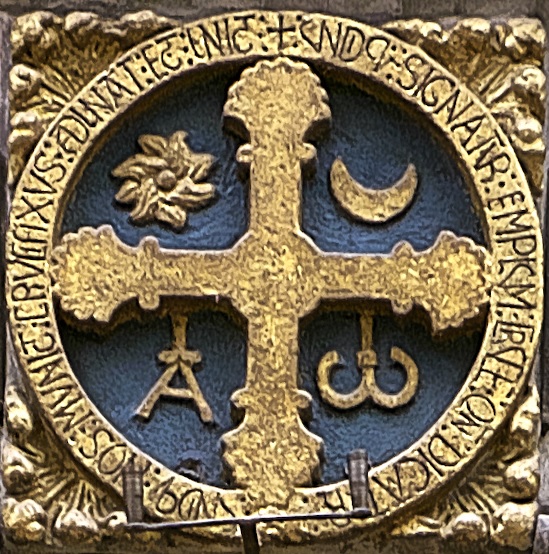
In Santiago, the twelve consecration crosses are works of stone, consisting of a cross within a circular belt, with an alpha and omega hanging from its arms, and a sun and moon occupying the spaces above them. Each belt contains an inscription, either recording the date of consecration or relating to an aspect of the ceremony. Although some were moved over the centuries, due to new construction works within the cathedral, over half are still in their original locations on the interior walls and bear witness to 800 years of Camino history.
[1] Vincent Debiais, ‘Writing on medieval doors: the surveyor angel on the moissac capital (ca. 1100)’, in Irene Berti, Katharina Bolle, Fanny Opdenhoff and Fabian Stroth (eds), Writing matters: presenting and perceiving monumental inscriptions in Antiquity and the Middle Ages (de Gruyter, Berlin, 2017), 285–308: 295.
 Denis Casey