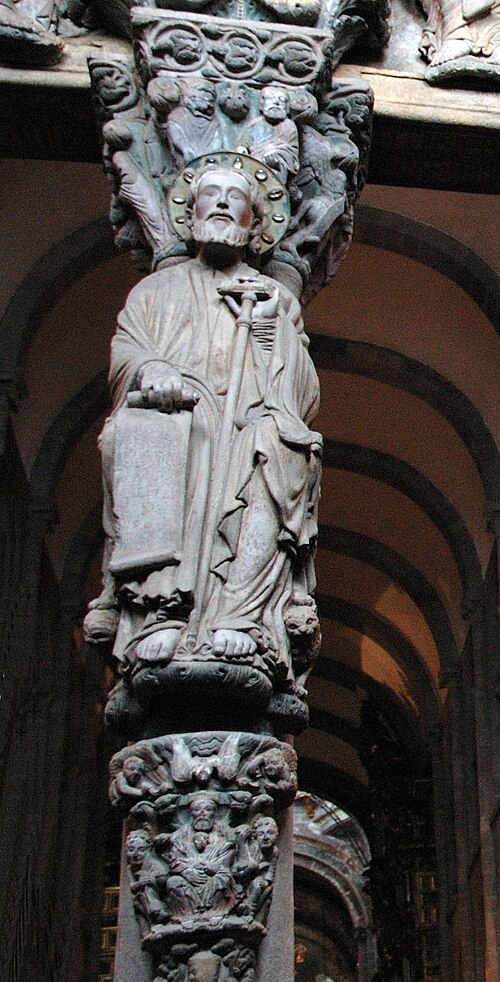
What is ‘authentic’ on the Camino? It’s a word that gets bandied about a lot but — having recently looked at the Pórtico de la Gloria app (available to download here) — I want to put a thought out there. Speaking as a medieval historian, I have no problem saying that the Pórtico is the single greatest collection of Romanesque sculpture in the world, and what is more, it is still in situ. Naturally, after eight centuries of facing Galician weather, it has seen its good and bad days, and has been subject to various interventions, most recently a 12-year conservation project financed by the Fundación Barrié, which ran between 2006 and 2018. The conservation project appears to have been undertaken with unprecedented thoroughness, and a feature on it in the ever-interesting RTVE programme La Aventura de Saber can be found by clicking here. The project’s investigations and activities prompt the question, what is it to be ‘authentic’?
The Pórtico has experienced various interventions, including additions to its ensemble (e.g. the nimbus/halo with crystals over Santiago in the central mullion (pilar)) and repainting in the Early Modern period that rouged up a few of the cheeks in the style of the time (comparable with the angels that hold up the canopy over the high altar inside). Would a conservationist be justified in removing the halo or the paint? You might argue that they would, as these were later additions, but if chronology is the yardstick for authenticity, when — or more importantly how — can we set a cut off date? The sculpture of Santiago has bourn that jewelled halo for more than half its existence and the prophets their face paint; more pilgrims have seen them with these than without them. They have become part of the fabric of the Pórtico.
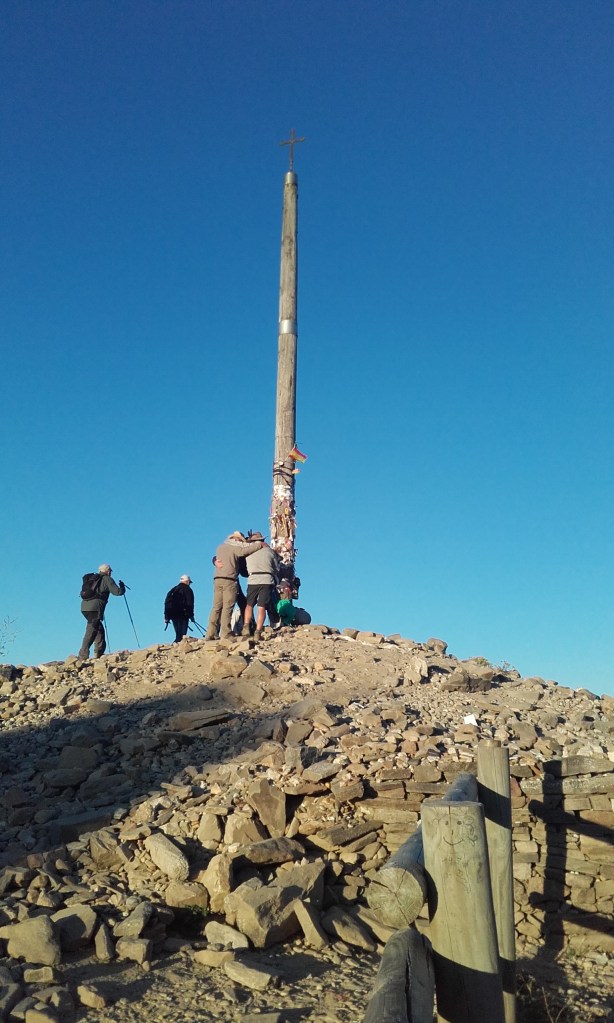
The danger lies in conflating ‘authenticity’ with ‘originality’. Just because something was not there the first day, it does not mean that it does not belong. The Cruz de Ferro (Iron Cross) to the west of León marks the highest point on the Camino Francés, yet to my knowledge was only erected in the 1950s. Does that make it inauthentic? For many, it is a deeply symbolic and emotive feature of their/the Camino. In 2023, I had the pleasure of meeting Len McDonald from Canada, a seasoned peregrino and man with great life experience, who was on a mission to deposit a portion of his brother’s ashes there, and swore to buy a glass of good whiskey for everyone to toast him afterwards. Sadly, I was ill for a couple of days and didn’t meet him, but before I made Santiago de Compostela I raised a glass in absentia, and nobody can tell me that those experiences connected to this 1950s monument were inauthentic.
 Denis Casey