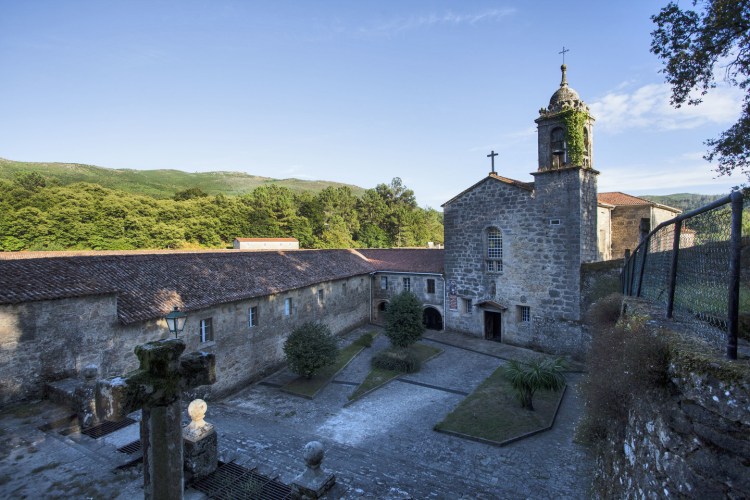
The title of this post might be a bit misleading because although it’s inspired by St Valentine’s Day, it’s not about those pilgrim romances that somehow develop while we’re all daily in a physically unattractive state that would never pass muster for a date in civil society. Rather it’s about a practice I encountered on the Camino Portugués, where locals at the Franciscan monastery near Herbón (just southeast of Padrón and about 30km from Santiago de Compostela) would drown a statue of St. Anthony in the hope of finding a lover.
Herbón’s claim to fame is that there pimientos de Padrón were first cultivated in Europe. These small peppers, fried in oil until blistered, are said to be sweet with one in twenty being spicy, and whether they were looking for sweet or spicy, locals would pray to a statue of St Anthony of Padua in the monastery grounds in the hope of finding love. If he didn’t deliver, they would upend the statue in a nearby water fountain until he provided.

Such an action might seem disrespectful and impious to us now, but it has good medieval pedigree. We are well acquainted with stories of the saints punishing those who show disrespect to their relics, cult sites etc. (e.g. the tenth-century Muslim soldiers who supposed left a trail of dysentery all the way home to Andalusia after plundering Santiago de Compostela), but the relationship worked both ways. The medievalist Patrick J. Geary in particular has written on the ‘coercion of the saints’, in which ordinary people would take the saint to task for their failure to abide by the unwritten social and devotional contract between saint and the community. Just as the people would afford the saint respect, honour and devotion, so too they were expected to intervene and provide for their followers.
Geary notes that actions taken against the saint’s relics or their representation (e.g. a statue) was carefully choreographed and carried out in a respectful manner.[1] One did not simply get the hump at receiving no Valentine’s Day cards and decide to waterboard the nearest statue of a Doctor of the Church. Rather rituals such as fasting were performed, the saint was politely addressed, and their options made known to them in advance. Only with the saint’s continued obstinacy were they to be Guantánamo-ed. It was a serious business, and could backfire if done disrespectfully.
So, if you do decide to take action post-February 14th, be sure to mind your Ps and Qs.
[1] Patrick J. Geary, Living with the dead in the Middle Ages (Cornell University Press, 2018).
 Denis Casey