As the feast of St Patrick falls in the middle of this month (17th March), I thought it might be a good time to look at Santiago’s position as patron of Spain and some of the challengers whom he has faced along over the centuries. I wrote previously about how Santiago’s position as patron was in part due to his promotion as a warrior saint in Castile, outdoing support for St Michael in the same role in Aragon. But in the sixteenth century, Santiago faced a much different challenger: Teresa of Ávila (1515–82).
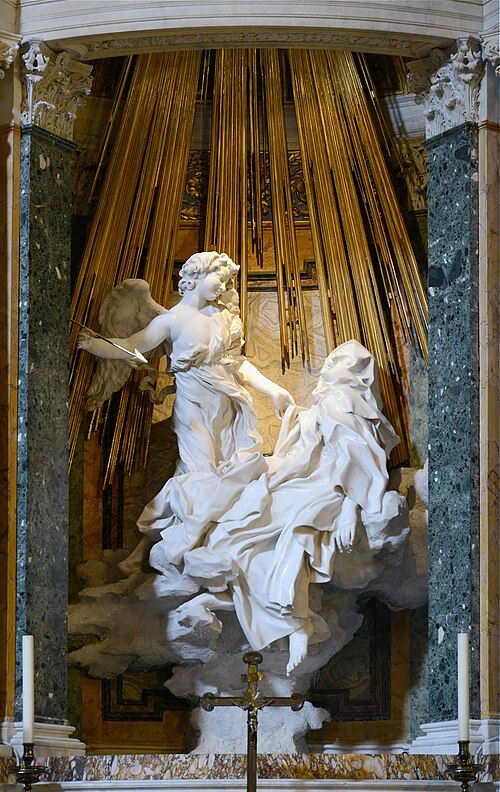
Teresa was a Carmelite nun and played a central role in monastic and spiritual renewal in sixteenth century Spain, and was one of the foremost proponents of Catholic mysticism of the time. Her experiences of mystic visions were audaciously represented in Gian Lorenzo Bernini’s statue in the basilica of Santa Maria della Vittoria (Rome), in which she lies in a trance at the feet of a mischievous looking angel holding a golden arrow, surrounded by marble reliefs of nobles in opera boxes voyeuristically enjoy a spiritual peep show.
This was a time when the Protestant Reformation was gaining traction in Europe, and thanks to her royal following (Philip II personally corresponded with her) and a feeling that since the Muslims had been expelled a new national helper was needed to face the challenges of the Reformation, movement was made toward declaring her patron of Spain after her canonisation in 1622. Such motivations for replacing Santiago with Teresa were not out of keeping with the times, for as Prof. John McCafferty pithily put it, ‘Counter-Reformation saints had to work for their living, as the cult of the saints constituted one of the fracture points between Catholics and Protestants’.[1] To use modern business parlance, she was seen to have the necessary ‘skillset’ of a modern patron.
Although Pope Paul VI named her the first female Doctor of the Church in the 1970s (one whose teachings or writings have had a significant impact on Church doctrine), the supporters of Santiago (spearheaded by the Cathedral of Santiago de Compostela) ensured that he was not elbowed out, although Teresa did become co-patron of Spain.[2] Given the ecumenical nature of the modern Camino de Santiago, perhaps it is appropriate that Santiago was not sidelined.
[1] John McCafferty, ‘Brigid of Kildare: Stabilizing a Female Saint for Early Modern Catholic Devotion’, Journal of Medieval and Early Modern Studies 50:1 (2020), 53–73: 53.
[2] Erin Kathleen Rowe, Saint and Nation: Santiago, Teresa of Avila, and Plural Identities in Early Modern Spain (Pennsylvania State University Press, 2011).
 Denis Casey