April, the month that Chaucer’s pilgrims saddled up for Canterbury, telling tall tales along the way, and in which the feast of Easter is most likely to fall. Anyone who has spent Easter in Spain will know of the impressive religious spectacles and processions held in many parts. While living in Navarre in 2022, I recall attending those in Pamplona with my friend István, joint owner of the camino shop Caminoteca in the city, and in 2024 I found myself helping stack benches in the Iglesia de San Miguel in Vejer de la Frontera, to make room for the exit of the paso (float) of the local hermanidad (fraternity), so it could process to the Iglesia del Divino Salvador. The most spectacular of these processions occur in the big cities of Andalusia, particularly Seville, Jerez, Málaga and Granada.
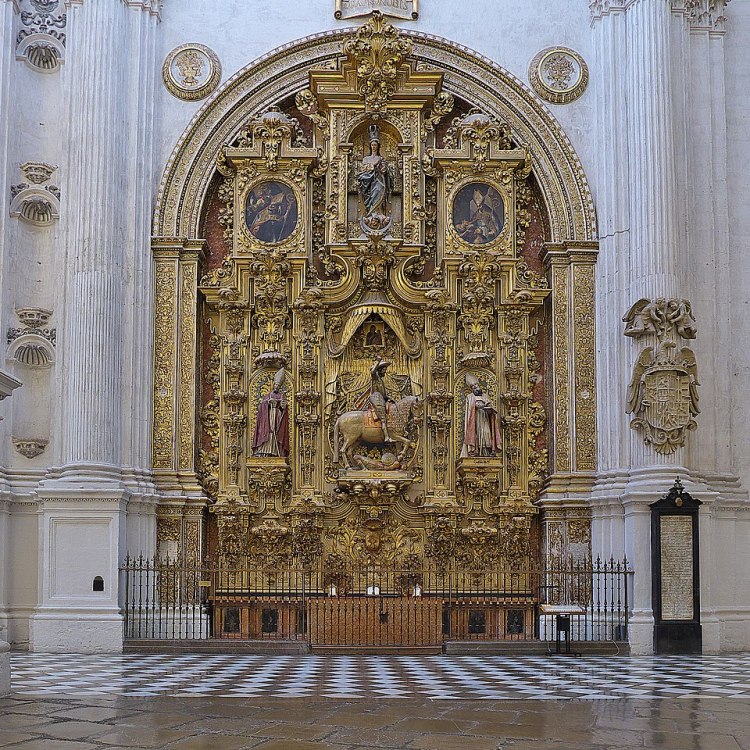
Many of these cities have camino routes passing through or starting in them, including Granada, where the cathedral is for many the starting point of the Camino Mozárabe (named for the Mozarabs — the Christians who lived in the Islamic parts of Iberia in the Middle Ages). That cathedral was largely designed by Diego de Siloé in the sixteenth century, and if his name sounds familiar it is because other examples of his work can be seen on the Camino Francés, like the magnificent Escalera Dorada (Golden Staircase) of Burgos Cathedral.
As the first truly renaissance cathedral in Spain, Granada has a bright and airy feel and interesting architectural features like its circular high altar. Elsewhere within the cathedral can be seen a more traditional altar of Santiago, with a gold-leaf decorated retablo from the first two decades of the eighteenth century behind it. The equestrian image of Santiago by the local sculptor Alonso de Mena is in the familiar Matamoros (‘the Moorslayer’) form, which may or may not be seen as appropriate, given that Granada was the last Muslim city in Iberia to submit to the Catholic monarchs, Isabella of Castile and Ferdinand of Aragon, in 1492. Directly above Santiago’s head is a small icon of La Virgen de los Perdones, a gift from Pope Innocent VIII to Isabella, which supposedly formed part of her portable altar. Given that she is buried in the adjacent capilla real (royal chapel), perhaps it’s fitting it rests here.
 Denis Casey