The wine of La Rioja

La Rioja is the smallest of Spain’s autonomous regions and is synonymous with quality wine in the way that Bordeaux is in France or Napa Valley in the US.  Indeed, it’s sometimes known as the Bordeaux of Spain, not least because French winemaking techniques were introduced to it in the later nineteenth century, which really helped it up its game and capitalise on its natural resources.

Two of its greatest resources are the tempranillo and garnacha grapes, which are often blended together in one of its staple reds.  Since varietal wines (wines made from a single type of grape) are increasingly popular, why blend?  Well think of it as a bit like your favourite football team.  You want your team to win and you want your manager (winemaker) to pick a winning team.  The manager has two types of player in the squad to choose from.  The first type is comprised of those silky smooth players who are a joy to watch on the ball and kick the scores that are an expression of the beauty of the game itself, but unfortunately they’re also a little too delicate at times and get muscled off the ball a little too easily — they’re the tempranillo.  The second type of player is that doughty ball carrier who knows how to get stuck into the opposition but isn’t always the prettiest to watch and a little lacking in the finer skills of the game — they’re the garnacha.  A team of tempranillos often won’t be heavyweight enough to win and a team of garnachas have the beef but not always the finesse needed for those game-winning scores.  But the manager who picks the right combination has a winning team on their hands; so it goes with blending tempranillo and garnacha.  Great wines can be made from either individually, but together they’re a satisfying combination that always stands a good chance of winning.

On the label of a Riojan wine you’ll often see Joven, Crianza, Reserva or Gran Reserva, and this refers to the aging of the wine, in barrel and bottle. Joven means young in Spanish and unsurprisingly refers to the youngest of the three; Crianza (meaning ‘cradle’) is the next oldest followed by Reserva, while Gran Reserva is the oldest.  Except for Joven wines, each of them must be aged in both oak barrels and in their bottle before being released onto the market.  Older wines tend to be more expensive partly due to storage costs (but you’ll often see restaurants put Crianza on their wine list and sell it at Gran Reserva prices, simply telling you it’s ‘Rioja’!).  However, although you often hear the expression ‘aging like a fine wine’ it doesn’t always follow that a young wine is an inferior product.  Not every wine is made for, or can withstand aging.  Some are best enjoyed sooner rather than later (which is particularly true of most white wines), while others are aged for longer in order to tease the fullest potential from the grapes.  And of course, fancy wine tastings are one thing, but wine drinking is quite another!

You’ll probably only spend about three days walking through La Rioja (roughly 60km), but don’t worry, their wine seems to be popular outside of there too.  If you’re interested check out the excellent official Rioja wine website, which even has a Rioja wine app that allows you to scan the bottle label for more information including how to purchase directly (especially useful if you find one that you’d love to have back home but don’t fancy dragging it another 600km to Compostela airport).

The botafumeiro: the oldest swinger in town

Apologies for the bad pun in the title, but one of the most impressive of all sights for pilgrims who reach Santiago de Compostela is the swinging of the botafumeiro — the great incense burner that hangs from the ceiling of the cathedral.  The botafumeiro (‘smoke expeller’) is essentially a version of the thurible (hand-swung incense burner) used in many church ceremonies, but this one is swung through the transept (side arms of the cathedral) by eight fully-grown men.  It stands at about a metre high and (depending on who you talk to/what you read) weighs anywhere between 50 and 160 kgs (8–25 stone), and watching it swing from the vault at over 60km/h you’re seriously hoping that the rope holds, because if it flies off it’ll be the equivalent of being hit by a small car…

References to the presence of a botafumeiro in the cathedral date back to the thirteenth century and it’s likely that there have been a few different ones employed over the centuries, not least because of theft.  In 1809 Napoleon’s troops stole the then silver botafumeiro and an iron one was used until the current botafumeiro of silver-plated brass was made in 1851.  Its job is to fill the air with the smell of sweet burning incense, a symbol of the purity of prayers rising up and also supposedly to cleanse the air of the smell of unwashed peregrinos!  In pre-modern times ‘bad air’ was considered a major cause of disease and so the botafumeiro was a health measure as much as a liturgical one.

It’s not operated every day, given the expense of incense and the effort needed, but normally you’ll get your chance to see it at the end of the weekly Pilgrim Mass and other special occasions.  Find a place in one of the pews in the transept, and if you’re really lucky, you’ll get to breathe in the history!

For a short video of the botafumeiro being swung, taken by a French peregrino in 2011, click here:

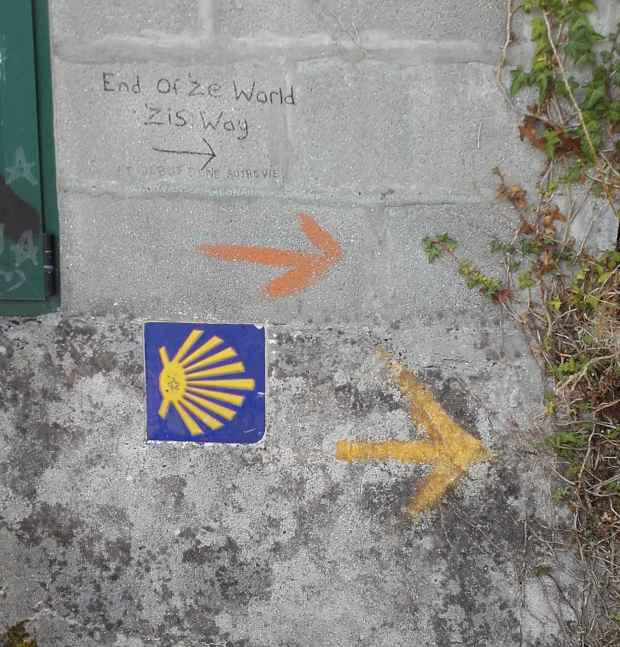
Yellow arrows and the Shell symbol


Yellow Arrows and Scallop Shell symbol

The yellow arrows and the scallop shell vie with each other for the honour of most recognisable symbol of the Camino and I think every perigrino’s heart has lightened on seeing them on those rare occasions when we’ve gone off the beaten track.  While the shell has a long association with the Camino, the yellow arrow is a modern innovation.  It was the brainchild of Don Elias Valiña Sampedro in the 1970s, a priest now buried at one of the oldest churches on the Camino, Santa María la Real, at O’Cebreiro (Galicia).  Don Elias was a historian as well as a priest and instrumental in reviving the Camino, through the judicious application of yellow paint on walls, rocks, trees and roads.  A story goes that at one time he was in eastern Navarre with his bucket and brush when his suspicious behaviour drew the attention of the Guardia Civil (one of Spain’s police forces).  What was he doing so near the border they asked?  To which he replied magnificently, “Preparing a great invasion from France!”[1]

The shell as a symbol dates back to the middle ages (see my History of the Camino), and the modern abstract version has a stellar quality, as befits something guiding the way to Compostela (‘Field of the Star’).  I’ve heard it said that the direction of the rays of the shell points toward Compostela but that some of Spain’s autonomous regions orientate the symbol the other way around, with all the rays converging in the direction of the Compostela.  To be honest, in my experience there doesn’t seem to be any rhyme or reason and the arrows are a safer bet, but as long as you’re heading roughly west (sun to your left) you’re ok.  However, the star-like quality of the shell symbol has another significance, one that complements the colour scheme and speaks to the future as much as the past.

It is no coincidence that the colour scheme of the shell symbol — yellow markings on a blue background — matches the yellow stars on a blue background of the European Union flag. By the mid-1970s dictatorships like that of Franco in Spain or the Regime of the Colonels in Greece were increasingly anachronistic and incompatible with evolving EU ideals, and after Franco’s death in 1975 and the subsequent transition to democracy, post-Franco Spain increasingly sought to locate itself within a modern Europe.  The Camino became a means of promoting Spain’s place in Europe — after all the road to Compostela had once been one of Europe’s most travelled highways and a magnet for people from all over northern Europe.  In 1986 Spain joined the EU (then EEC), and the following year the Camino was designated the first Cultural Route of the Council of Europe, in recognition that:

For centuries, pilgrims could discover new traditions, languages and ways of life and return home with a rich cultural background that was rare at a time when long-distance travel exposed the traveller to considerable danger. Thus the Santiago Routes serve both as a symbol, reflecting ever one thousand years of European history, and as a model of cultural co-operation for Europe as a whole.[2]

If you’re from the UK and you voted for Brexit, you might want to think twice about getting that scallop shell tattoo!

[1] Anxo Saco, ‘Who was Elías Valiña? Follow the yellow arrow!’, https://caminotravelcenter.com/who-was-elias-valina-follow-the-yellow-arrow

[2] Council of Europe, ‘Santiago de Compostela Pilgrim Routes’, https://www.coe.int/en/web/cultural-routes/the-santiago-de-compostela-pilgrim-routes

The oldest guide to the Camino

Santiago, from the Codex Calixtinus, available at Wikimedia Commons

Keeping donkeys for oral sex does not seem like the kind of thing you would normally associate with a travel guide, especially one dedicated to a pilgrimage, but sure enough there it is in the oldest guide book to the Camino, the twelfth-century Pilgrim’s Guide in the Codex Calixtinus:

In some places, like Vizcaya and Alava, when they get warmed up, the men and women show off their private parts to each other. The Navarrese also have sex with their farm animals. And it’s said that they put a lock on the backsides of their mules and horses so that nobody except themselves can have at them. Moreover, they kiss lasciviously the vaginas of women and of mules.[1]

In condemning the loose morals of the people he encountered, the author reserved particular scorn for the Basques and Navarrese, and yet the Pilgrim’s Guide now has an important place in Basque scholarship, as it contains some of the earliest examples of the Basque language committed to writing.

The Pilgrim’s Guide is the fifth of the five sections in the Codex Calixtinus (Latin for “Callixtus’ Book”), which forms a kind of anthology on the cult of St James/Santiago, including accounts of miracles, legends and liturgies.  Its alleged author was Pope Callixtus II (died 1124), who is known for (among other things) writing the papal bull Sicut Judaeis (a letter of universal protection for Jews) and restoring the Basilica of Santa Maria in Cosmedin, in Rome (which featured in the Audrey Hepburn-Gregory Peck film Roman Holiday).  It’s not entirely clear why Callixtus should be associated with the Codex, but he had good connections with the lands of the Camino, as his brother Raymond of Burgundy married Urraca, heiress and future queen of León, and Raymond himself ruled Galicia under his father-in-law, in the 1090s.

The manuscript is now kept by the Cathedral of Santiago de Compostela and many of you who have completed your Camino may be familiar with it without even knowing — on your Compostela (certificate of completion) is an image of Santiago, hand raised in benediction, taken directly from the Codex Calixtinus.  If that piques your interest you can buy some nice stationary featuring it in the cathedral shop, order a limited-edition facsimile – a steal at a mere €1900 online[2] – or just steal the real thing like a disgruntled cathedral employee did in 2011![3]


[1] Denis Murphy’s very readable translation of the Pilgrim’s Guide (perhaps the most accessible translation in English on the internet), can be found here: https://sites.google.com/site/caminodesantiagoproject.  The quotation is take from ‘Chapter VII. The lands and peoples along the Camino de Santiago’: https://sites.google.com/site/caminodesantiagoproject/chapter-vii

[2] https://codexcalixtinus.es/

[3] ‘Cathedral thief gets 10 years for stealing 12th-century manuscript’, El País (18 Feb 2015): https://english.elpais.com/elpais/2015/02/18/inenglish/1424275570_591038.html

Portmagee, Co. Kerry: the origins of an Atlantic smuggling village

My latest book – a history of the village of Portmagee, Co. Kerry from the Bronze Age to modern times – is now available to buy from Four Courts Press.

For more on my other writings, click Fiction, History Books or Academic in the toolbar above – whichever type takes your fancy!

Tigernán Ua Ruairc and a twelfth-century royal grant in the Book of Kells

Published in the Maynooth Studies in Local History series and available here from Four Courts Press

The world-famous Book of Kells originally contained several land transactions records that shed light on the ecclesiastical and secular politics of eleventh- and twelfth-century Ireland. This study examines one by Tigernán Ua Ruairc, the famous king of Bréifne who is popularly remembered in connection with the English invasion.