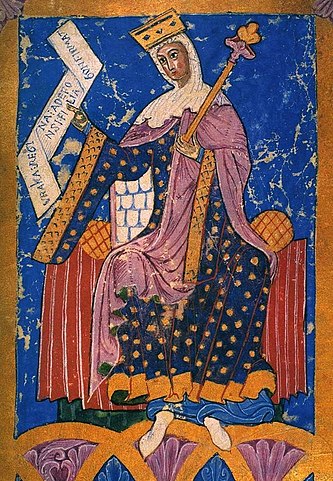
Hello to Kate and her Crew on the way to Santiago!
I thought a post on the work of a strong woman would be eminently appropriate, and who better than Urraca, Queen of León, Castile and Galicia (1081–1126) — a prudent and modest Jezebel possessed of good sense (in the mixed judgement of Diego Gelmírez’s Historia Compostelana).
In a time when females ruling in their own right was essentially unknown, she was ‘Empress of All Spain’, and as the only legitimate child of King Alfonso VI (‘the Brave’) of León and Castile, the already widowed Urraca inherited his lands in 1109. She was forced into a second marriage with Alfonso I (‘the Battler’) of Aragón and Navarre and civil war broke out in Galicia, with the fractious nobility promoting the right of her young son from her first marriage to rule (not necessarily a sexist move, but probably because they hated the Aragonese). She was initially backed by the militarily adept Archbishop of Santiago, Diego Gelmírez/Xelmírez — ‘Santiago’s Catapult’ — although he flipflopped (an essential figure in the development of the cathedral at Compostela). War with her cruel husband also followed, and in her fight against him she counted as allies and lovers some of her kingdoms’ most significant nobles. Although the peace saw her lose some Castilian territory, essentially she won the right to be recognised as de jura queen, with the ability to transmit her crown to her own heirs.
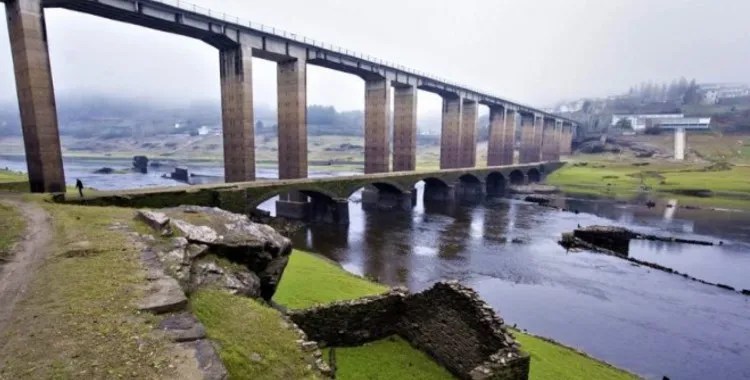
According to the twelfth-century Pilgrim’s Guide, Urraca had the bridge over the river Miño at Portomarín destroyed during her war against her husband. Further destruction was caused by the damming of the river to create the Belesar reservoir in the late 1950s, although most of the town was moved to higher ground, including notable buildings like the Order of St John’s fortress-like Iglesia de San Juan. From the modern bridge over which you pass on the way into the town you may see (if the water level is sufficiently low) the remains of that Roman bridge below.
If you want to toast Urraca, Portomarín holds a celebration of its local liquor— the Fiesta de la Aguardiente. It comes in a variety of flavours, including unleaded and premium.


One thought on “Queens and the Camino”