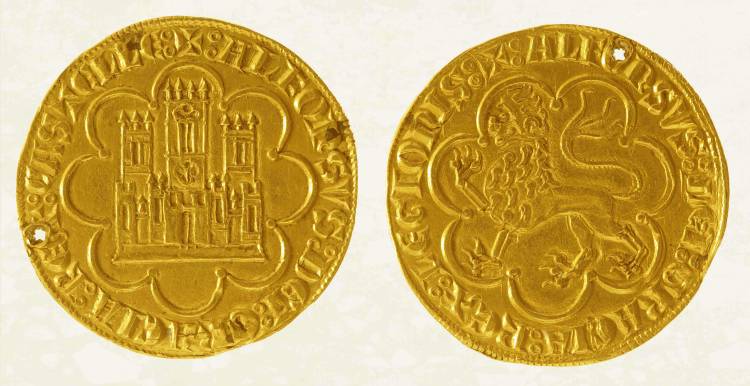
The euro, SEPA (Single European Payments Area), Revolut — they’ve all made paying for things on the Camino a lot easier in recent years. It’s not that long ago (only a little over twenty years) that a pilgrim would still have had to go to their local bank and put in an order for pesetas before travelling. Calculations would have to have been made about how much was necessary per day for accommodation, food, etc. on the basis of dubious information (probably by chatting to a Camino-know-it-all like myself), a wedge of notes might take a while for the bank to obtain, and it had to be husbanded over the course of the journey. In some respects, the medieval or early modern situation was not that much different.
Depending on their starting point and route, a pilgrim might have to travel across several kingdoms, each with its own coinage (no notes), which was nigh-on impossible to obtain in advance. When moving on, they had to be conscious of not being lumbered with coinage that would be impossible to exchange and essentially represent lost money. A pilgrim often carried the entire sum of their return journey with them and accident, theft, or bad luck at cards or dice, could leave even a well-to-do pilgrim reliant upon charity. Some pilgrims ran up bills and did a ‘dine-and-dash’ (or what would probably be a ‘dine-and-hobble’ on the Camino), like the infamous Gerald of Wales, who for all his chauvinistic self-righteousness proved himself to be nothing more than a thief when he high-tailed it out of Rome in 1203, with a string of creditors behind him pursuing him all the way to Bologna.[1]
As Jonathan Sumption has observed, from the fourteenth century onwards the life of a wealthy traveller became easier, with the development of international banking systems, such that pilgrims could obtain bills of exchange and hoteliers on certain pilgrim routes acted as bankers of sorts.[2] Certain coinage systems became more widely accepted, and within the Iberian peninsula Castilian coins — many of which were based upon the coinage of Al-Andalus (Muslim Iberia) — were probably accepted generally. Regardless of how well a pilgrim managed their finances, it could still be an expensive enterprise. It has been estimated that the cost of travelling from Scotland to Rome in the middle of the fifteenth century was the equivalent of the annual income of a well-to-do knight (£66 sterling or £200 scots), but passage on a ship from Ireland to Spain on a Jubilee Year during the same period might cost as little as 7s 6d, making it a vastly more affordable option and opening up pilgrimage to people a lot less wealthy.[3]
For today’s pilgrim, the move to a cashless economy needs to be treated with caution out of consideration for those operating the Camino infrastructure. Very few albergues/hostels have electronic payment systems, and the few remaining donativos (whose generosity is being stretched to breaking point, causing many to abandon the donation system) are particularly vulnerable. A few notes in your wallet won’t weigh you down, but may lighten their load considerably.
[1] Jonathan Sumption, The Age of Pilgrimage: the Medieval Journey to God (Mahwah, New Jersey, 2003), 291–2. (Originally published as Pilgrimage (London, 1975)).
[2] Ibid., 292–3.
[3] Bernadette Cunningham, Medieval Irish Pilgrims to Santiago de Compostela (Dublin, 2018), 20 and 113. Bearing in mind that the 7s 6d probably only got you the right to sleep somewhere on the ship’s exposed deck and covered none of the rest of your expenses.
 Denis Casey