The most famous military orders from the middle ages are undoubtedly the Knights Hospitaller (who still survive in the form of the Order of Malta) and the Knights Templar (who have no end of occult junk written about them). Within Spain a number of prominent orders were established, most notably those of Calatrava, Alcántara, Montesa and Santiago, a number of which had Irish members in later centuries.
The military orders were established with the two-fold purpose of pursing conventional religious aims and fighting the ‘infidel’, while the Order of Santiago also had the protection of pilgrims on their way to Santiago de Compostela as part of its remit. From the twelfth to the fifteenth centuries the orders became increasingly wealthy, acquiring vast tracts of land, while they participated in and benefited from the southward expansion of Castile, Aragon and Portugal (the Christian kingdoms of northern Iberia). By the late fifteenth century the opportunities for fighting the ‘infidel’ in Iberia were limited, and membership of the orders increasingly became a marker of social prestige.
The first Irishman to be accorded such an honour was Domnall O’Sullivan Beare, lord of Beare and Bantry (Cork & Kerry), who was one of Hugh O’Neill’s principal supporters during the Nine Years War (1593–1601). Having failed to make his peace with the establishment he went into exile in Spain 1603, and there, as Michelene Walsh notes in the introduction to her authoritative four-volume Spanish Knights of Irish Origin, he was admitted to the Order of Santiago and uniquely accorded the title Conde de Birhaven (Count of Beare); no other exile was awarded a title in the Spanish peerage whose territorial foundation was in Ireland.[1]
He was to die by the sword, or rather the dagger, and an Old English one at that. In very disputed circumstances, his kinsman Philip O’Sullivan Beare fought a duel against John Bathe, a member of a prominent Dublin Catholic Old English family (a brother of whom had been a favourite of Elizabeth I before becoming a priest and composing one of the sixteenth-century’s most printed and plagiarised guides to learning Latin).[2] O’Sullivan Beare intervened, and like Mercutio in the contemporary Romeo and Juliet, he came out the worse for it, his throat slashed open and died on a Madrid street. Bathe was rumoured (probably rightly) to have been an English agent, and later tried to gain credit with the government for ‘removing’ the only Irish noble who had not been officially forgiven by James I.[3]
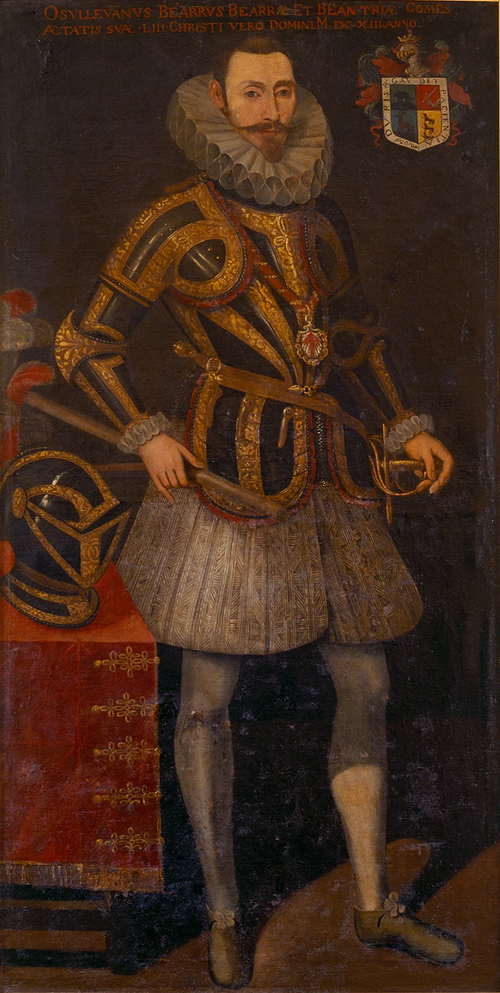
A seventeenth-century portrait of O’Sullivan Beare hangs in St Patrick’s College, Maynooth and a nineteenth-century copy in UCC. In it, he can be seen wearing the insignia of the Order of Santiago around his neck (the pendant with a scallop shell bearing a red cruciform sword lies just above his belt) and the portrait bears the date 1613. The problem with this date, as Professor Hiram Morgan points out, is that it predates his admission to the order by four years (1617).[4] It may be that the model for the portrait was not O’Sullivan at all and the title only subsequently added, or that the insignia of the order was subsequently painted in, to recognise his admission to the Spanish elite.
[1] Micheline Walsh (ed.), Spanish knights of Irish origin (4 vols, Irish Manuscripts Commission, Dublin, 1960–78), i, p. v.
[2] Denis Casey, The Nugents of Westmeath and Queen Elizabeth’s Irish Primer, Maynooth Studies in Local History 123 (Dublin, 2016).
[3] Robert Armstrong, ‘Sir John Bathe (Bath)’, Dictionary of Irish Biography (Cambridge University Press and Royal Irish Academy, 2009), https://doi.org/10.3318/dib.000492.v1.
[4] Marc O’Sullivan Vallig, ‘Cork In 50 Artworks, No 17: Portrait of Dónal Cam O’Sullivan Beare’, Irish Examiner, 16 August 2021: https://www.irishexaminer.com/lifestyle/artsandculture/arid-40358828.html

