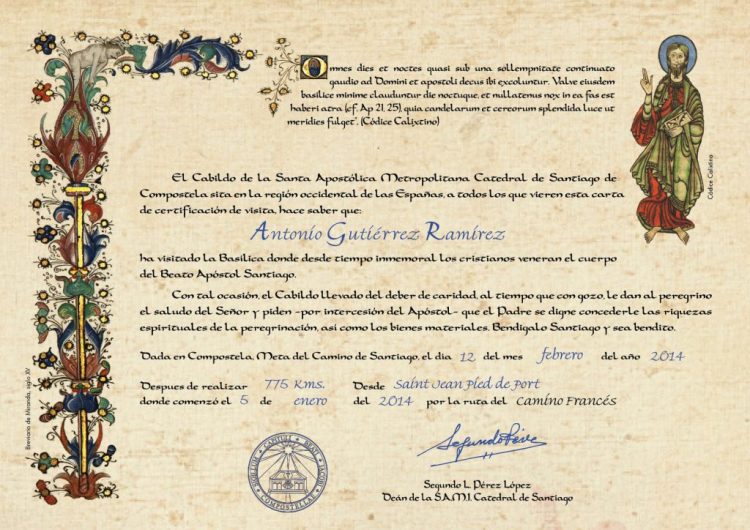
Whether you have one Camino under your belt or are a recidivist peregrino, there is always something special about getting your Compostela (certificate of completion) and Certificate of Distance at the Pilgrim Office in Santiago de Compostela. The office’s title in Spanish is the Oficina de acogida al peregrino — Office of Welcome to the Pilgrim — and that sense of welcome permeates their work. There is a buzz in the air as the queue snakes within (and sometimes outside) the building, you occasionally bump into people you have met along the way, and it is a tribute to the staff who deal with thousands of pilgrims every day that they do so with a smile and celebrate your achievement with more than just paper and a cardboard tube. However, that is not to say that the paper validation in the form of the Compostela and Certificate of Distance are not nice mementos, albeit they come in languages that many pilgrims struggle to understand (Latin and Spanish, respectively). Since translations are available online,[1] I thought it might be interesting to look briefly at a particular aspect of their decoration, namely the figure in the top right-hand corner delivering a blessing to the recipient.
At first glance, the figure in the top right of the Compostela and Certificate is somewhat ambiguous; it could represent either Santiago or Christ. It is taken from the twelfth-century Codex Calixtinus (fol. 4r), and depicts a bearded man standing barefoot, holding a book or box in his left hand and bestowing a three-fingered blessing/making the sign of the cross with his right (the three digits signifying the Trinity). The colours of his clothing favour viewing him as Christ, who is often depicted wearing a red robe (signifying divinity), covered by a green/blue cloak (symbolising humanity), combining to represent His two natures. Against this, neither the hands nor feet show signs of nail wounds, and on balance it is probably a portrait of the apostle.
Significantly, Santiago is neither depicted as Matamoros (mounted on a white horse and riding into battle) nor peregrino (with pilgrim staff, broad-brimmed hat and shell); both of those representations date from the high/late middle ages, and have dominated how he is portrayed to the present.[2] At the time the Codex Calixtinus was compiled, it was usual to represent Santiago in a more ‘traditional’ apostolic guise (in so far as portraits were common), and in this he can be compared to the roughly contemporary figure of Santiago in the mullion (central column) of the Pórtico de la Gloria, at the western entrance to the cathedral of Santiago de Compostela. There, seated, he holds an open scroll in his right hand and a tau-shaped crozier in the left, with neither shell nor horse in sight.[3]
As Rod Stewart sang, ‘every picture tells a story’, and those in the Compostela and Certificate tell more than one. In their original manuscript contexts they showcased artistic influences and spoke to the texts they accompanied. Likewise, they were not chosen at random for inclusion in our pilgrim mementos. They speak to the long history of the Camino, blessings imparted, and reflecting the words of the Codex Calixtinus quoted at the top of the Certificate, to doors that are never closed.
[1] For example, for a translation of the Compostela, see Oficina de acogida al peregrino, ‘The Compostela’: https://oficinadelperegrino.com/en/pilgrimage/the-compostela/ (accessed 22 August 2026).
[2] English readers may enjoy the happy coincidence that in the manuscript it is found at the opening of Quoniam beati Jacobi vigilias, a sermon for the vigil of the feast of Santiago, attributed to the Venerable Bede.
[3] A discussion of representations of Santiago can be found in Stephen B. Raulston, ‘The harmony of staff and sword: how medieval thinkers saw Santiago Peregrino & Matamoros’, La corónica: A Journal of Medieval Hispanic Languages, Literatures, and Cultures 36:2 (Spring 2008), 345–67.

