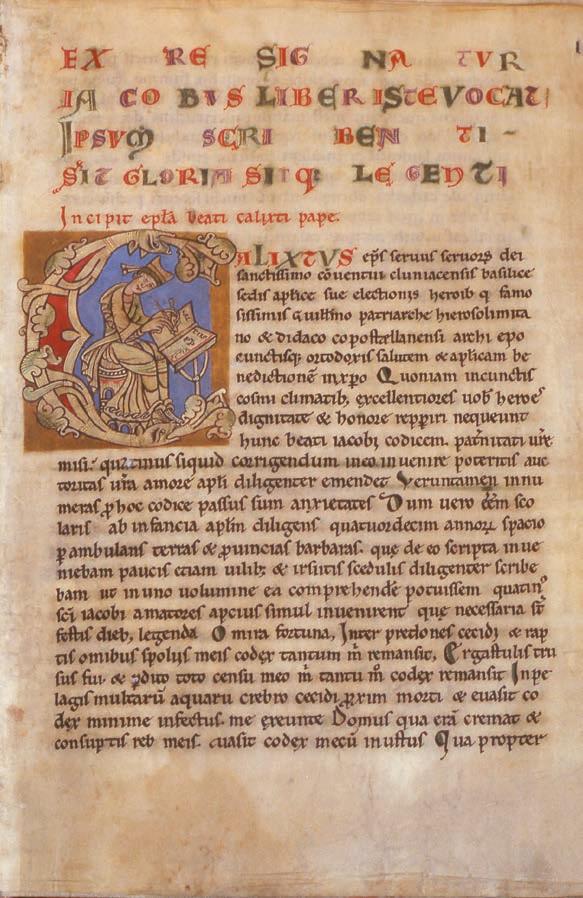
The Codex Calixtinus (Book of Calixtus) is a large medieval volume housed in the archive of the cathedral of Santiago de Compostela (for which it was produced), and has left its mark all over the Camino. As seen previously, the decorations of the certificates pilgrims receive upon completing the Camino are derived from it, and many of the legends and traditions associated with Santiago are first recorded in it. The codex is named for Pope Calixtus II (reigned 1119–23) to whom it was spuriously attributed, and was probably produced in the last quarter of the twelfth century. However, Calixtus did have strong Spanish links in that his brother Raymond of Burgandy was married to Urraca, Queen of León, Castile and Galicia (1081–1126), and he was the father of the future King Alfonso VII of León.
Like many a medieval volume, the Codex Calixtinus is a compilation of texts or books around a particular theme or interest, in this case the cult of St James/Santiago. Originally the manuscript consisted of five books:
- liturgical material in honour of Santiago
- miracles of Santiago
- translation of the body of Santiago from Jerusalem to Santiago de Compostela
- the History of Charlemagne (or Chronicle of (pseudo-)Turpin)
- the Pilgrim’s Guide.
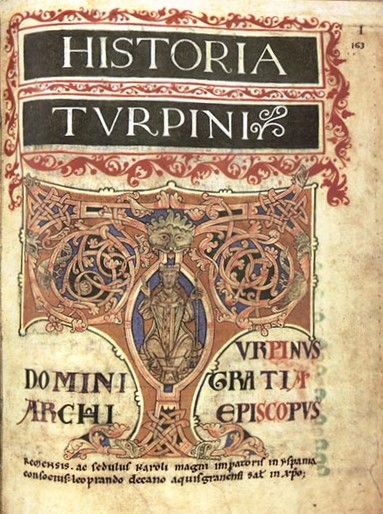
Book Four (which was removed during the codex’s rebinding in the seventeenth century) is a romantic tale about Charlemagne’s supposed campaigns in Spain and proved extremely popular in the middle ages (the historic Charlemagne did indeed campaign in what is now Navarre and Catalonia, but his connections with Santiago de Compostela are spurious). It was even translated into Irish in the later middle ages under the title Gabháltais Shéarlais Mhóir (‘The Conquests of Charlemagne’), and edited and translated by Douglas Hyde, subsequently first president of Ireland, in 1919, and I uncovered a further hitherto unrecognised copy of it in the Cambridge University Library in 2010.[1]
For those interested in music, the Codex Calixtinus is believed to contain the first example of a composition intended for three voices. I don’t claim to know anything about music, but apparently some scholars disagree that this is what is represented on the page or at the very least maintain that it is poorly executed.[2] And while for many it is a milestone in the development of music, for the Camino it is a cornerstone.
[1] Denis Casey, ‘Hidden treasures in the Cambridge University Library’, Anglo-Saxon, Norse and Celtic Blog (18 May 2010): https://anglosaxonnorseandceltic.blogspot.com/2010/05/hidden-treasures-in-cambridge.html.
[2] The Digital Image Archive of Medieval Music, University of Oxford: https://www.diamm.ac.uk/sources/3970/.


One thought on “The Codex Calixtinus (Book of Calixtus), the most important book in the history of the Camino”