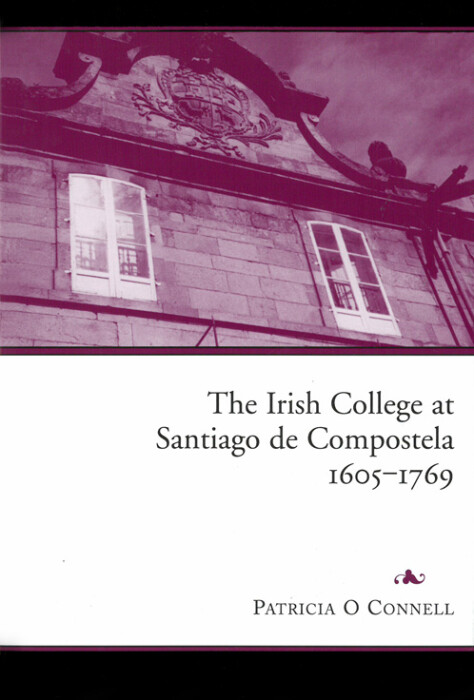
In a previous post (back in May) I discussed the portrait of Ireland’s first member of the Knights of Santiago, Domnall O’Sullivan Beare, and what I’d like to do now is briefly look at the connections of the O’Sullivan Beare family with the Irish College in Santiago de Compostela, which operated for over 150 years in the seventeenth and eighteenth centuries.
Irish colleges were founded across Catholic Europe in the sixteenth and seventeenth centuries to educate students from Ireland (or of Irish descent) and were generally under the control of religious orders e.g. the influential college of St Anthony in Louvain (Spanish Netherlands) was controlled by the Franciscans. While popularly viewed as seminaries, not all were established specifically for training men for the priesthood, although many were or their mission eventually evolved that way (and of course not all students followed that path). By and large, they were intended as a tool of the Counterreformation, providing an education for the Catholic elite and preparing missionaries to return to Ireland and combat Protestantism. Of the twenty-nine Irish colleges in Continental Europe, one was in Portugal (Lisbon), and five in Spain, namely Salamanca, Seville, Madrid, Alcalá de Henares, and of course Santiago de Compostela.
The Irish College in Santiago was founded by O’Sullivan Beare in 1605 and found a home at 44 Rúa Nova a decade later, and the royal coat of arms can still be seen on the building’s exterior, now a private dwelling (as described by former Camino Society Ireland chairman Turlough O’Donnell).[1] The college was constantly strapped for cash and consequently could only house a maximum of 16 students, who were offered instruction in philosophy before they transferred to the Irish College in Salamanca, many in preparation for the priesthood. The college was run by the Society of Jesus (Jesuits) and closed after their expulsion from Spain in 1767, after having educated over five hundred students.[2]
While Domnall O’Sullivan Beare had founded the Irish College in Santiago, his nephew Philip ended up being expelled from it for opposing the Jesuit takeover of the college in the 1610s. Catholics from Ireland were not one big happy confessional family and divisions between Gaelic Irish Catholics and Old English Catholics were broadly reflected in the religious orders they were inclined to join; the Gaelic Irish more likely to become Franciscans and the Old English to join the Jesuits. As the Old English had not supported Hugh O’Neill’s rebellion, which led to the exile of the O’Sullivan Beares, it is understandable that frictions existed. Indeed this was an important feature of Philip’s Historiae catholicae Iberniae compendium (‘Compendium of the history of Catholic Ireland’) published in Lisbon in 1621; naturally it did not go down well with the Old English community. Interestingly, the rhetorical strategies of his works seem to show influence of Jesuit practice,[3] suggesting that he learned something from them in Santiago!
[1] Turlough O’Donnell, ‘The Irish and Santiago de Compostela’, https://www.caminosociety.ie/theirishandsantiago.
[2] The most authoritative work is Patricia O’Connell, The Irish College at Santiago de Compostela, 1605–1769 (Four Courts Press, Dublin, 2006).
[3] Hiram Morgan, ‘Philip O’Sullivan Beare’, Dictionary of Irish Biography (Royal Irish Academy, 2009), https://doi.org/10.3318/dib.007079.v1.

