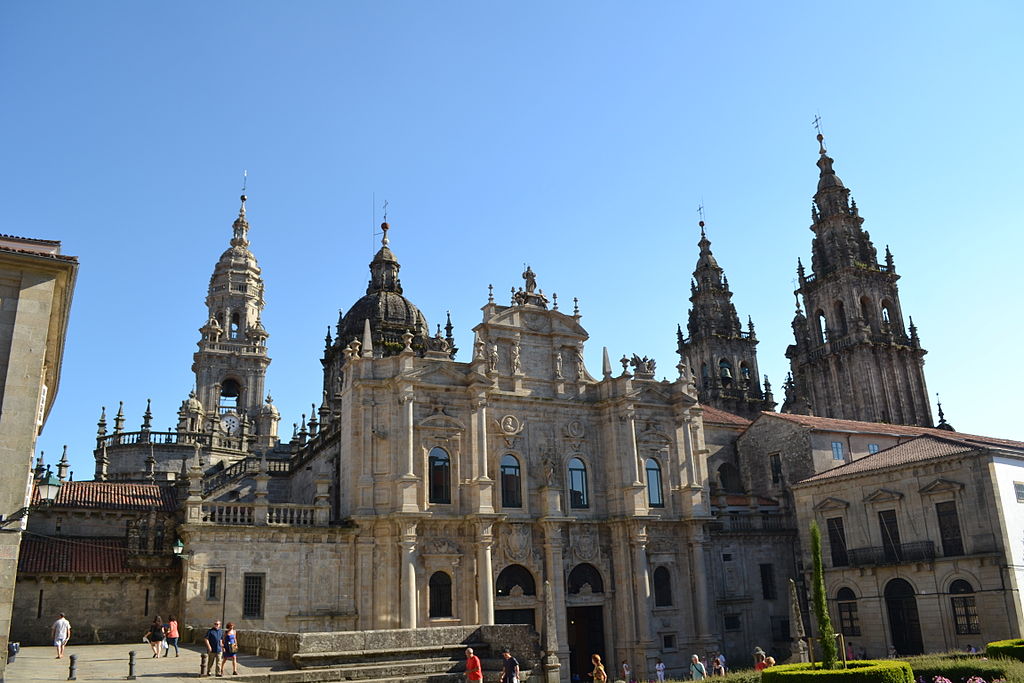
Guides and Guidebooks: Good and Bad

The recent passing of John Brierley, the author of some of the most popular and high-quality guidebooks to the Camino, had me thinking about guides and guidebooks.  I was in Santiago de Compostela in June, finishing the Camino Francés that I began in 2021, and had two contrasting guide experiences. 

I bought a guidebook in the Cathedral shop (ok I bought a few books there), and here’s an excerpt from its description of the seventeenth-century Chapel of Christ of Burgos:

“It is a noble proto-Baroque construction with a portal with double columns on dies to hold the founder’s shield in the attic.  It has a Grecian groundplan and an architraved structure with great fluted pilasters supporting double coffered arches.  The dome has pendentives bearing Carillo’s arms and ribs worked to form shells pouring water”.[1]

I have a PhD in medieval history and have occasionally taught on related architecture, but even if I did recognise all the terms (recognise ‘yes’, remember/be able to explain, ‘no’), it doesn’t make for exciting reading.  I found myself in agreement with the great Renaissance writer Michel de Montaigne:

“I cannot tell if others feel as I do, but when I hear our architects inflating their importance with big words such as pilasters, architraves, cornices, Corinthia style or Doric style, I cannot stop my thoughts from suddenly dwelling the magic palaces of Apollidon: yet their deeds concern the wretched parts of my kitchen-door!”[2]

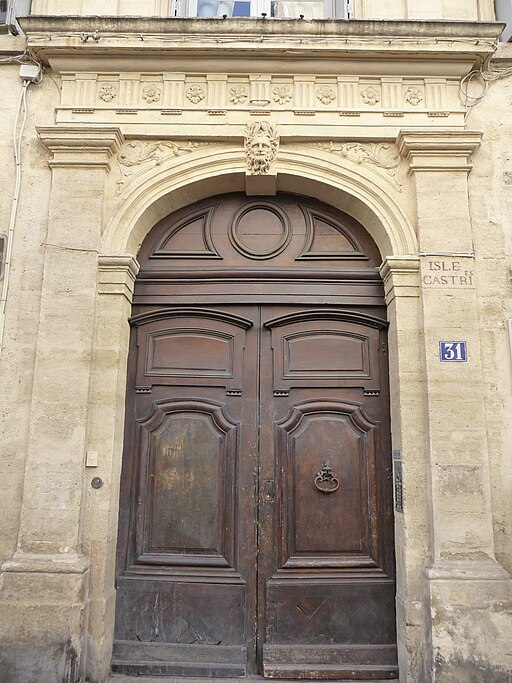
Ok, so the Chapel of Christ of Burgos is a little more impressive than the kitchen door of my flat, but you get the point.  It’s all very well to complain, but how would I do it differently?  I think if I were to author a guidebook to the Cathedral, I’d begin by taking a particular feature (e.g. a single chapel) and use it to explain the terminology, and architectural and artistic ideas that are found in other parts of the building e.g. this is a ‘pilaster’ a decoration against a wall that’s designed to look like a column, but actually just for show and not holding anything up.  It’s the teacher in me coming out.  Teach them what they’re looking at first, and then help them discover the same elsewhere themselves.

Pilasters at either side of a door – they look like columns but they’re not supporting anything. Image by Albertvillanovadelmoral – Own work, CC BY-SA 3.0.

My second guide experience was with a live guide, taking the Cathedral rooftop tour, such a bargain at €8!  It’s not for those who suffer from fear of heights, and you need to be mobile, but for everyone else I’d recommend it.  With a radio-earphone connection the young lady guiding us led us around the ongoing roof works, discussing the competing needs of conservation and desire for accessibility, explaining functions and design ideologies, connecting us with the parts of the cathedral directly below, sharing how some of the Camino practices of today (e.g. burning items of clothing in Finisterre) link with both the history and features of the cathedral, etc.  All in all, even though I probably only followed about 90% of it (it was in Spanish), it was the best guided tour I’ve ever had in Spain.


[1] Alejandro Barral and Ramón Yzquierdo (trans. Gordon Keitch), Santiago Cathedral: A Guide to its Art Treasures (5th edition, 2019), p. 92.

[2] ‘On the Vanity of Words’, in Michel de Montaigne (trans. M.A. Screech), The Complete Essays (London, 1991), p. 343.

The Irish-Spanish Inquisition Alliance

In a previous post I wrote about the medieval Spanish inquisition and its relationship with the Camino de Santiago.  The Black Legend of the Inquisition in the early modern period – the horror story version of its activities created in Protestant Netherlands and Britain – still dominates the popular image.  That is not to say that there isn’t some truth to it, and certainly they were no cuddly crew, but as Prof Alec Ryrie pointed out, the numbers executed during its heyday only exceed by a few hundred the number of people executed in US federal jails since 1970.  Recently, I had the opportunity to read Professor Tom O’Connor’s book Irish Voices from the Spanish Inquisition,[1] which I won’t say changed my mind about the Inquisition or Irish people in the early modern Iberian world, but rather substantially enhanced my understanding.

O’Connor draws upon Inquisition (and other) documentation to show how the organisation was incredibly adept at reimagining itself to meet the needs of the Spanish monarchy.  Beginning as a doctrinal police, it evolved into a kind of naturalisation service – migrants to Spanish territories could engage with the Inquisition to get a clean bill of spiritual health (so to speak), which facilitated their entry, engagement and incorporation into Spanish society.  Irish engagement with the Inquisition played on their dual position as Catholics and subjects of the Protestant English crown, to act as brokers in the uneasy trading arrangements between two religiously, economically and imperially opposing powers.  In doing so, Irish Catholics engaged with the Inquisition in a self-interested manner, acting as translators, facilitators and occasional proselytisers.

Certainly the Inquisition never lost its doctrinal focus, but it was increasingly pressed into supporting the needs of the state, and sometimes muzzled when it did not.  The picture that emerges is of a seventeenth- and eighteenth-century Inquisition that functioned more as a Department of Naturalisation for the government, rather than a Gregorian-Chant Gestapo. 


[1] Thomas O’Connor, Irish Voices from the Spanish Inquisition: Migrants, Converts and Brokers in Early Modern Iberia (London, 2016).  Available for purchase at: https://doi.org/10.1057/9781137465900.

The Pilgrim’s Crowbar: Stealing Relics in the Middle Ages

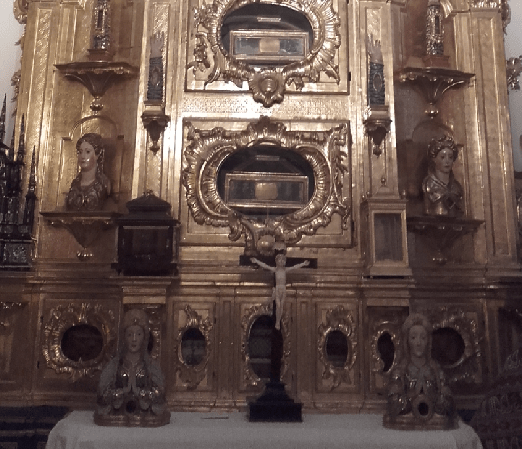
Chapel of the Relics, Burgos Cathedral (Image: Author’s Own)

Medieval people went on pilgrimage for many reasons (e.g. seeking forgiveness, gratitude for favours received, as punishment etc.), but you’d be forgiven for thinking that theft would not be a motivating factor.  After all, why would a devout person go on pilgrimage with the express aim of stealing, and especially to steal something holy?

But robbing relics – especially the corporal remains of saints – was serious business in the middle ages and for many pious people (and not just habitual/professional thieves) it was perfectly acceptable and even commendable.  They justified it saying that the saints were perfectly capable of defending themselves, so if they didn’t want to go, the ‘thief’ would not succeed; if he/she did succeed, it was a sign that the saint wanted to be venerated elsewhere.  Naturally the saint’s followers didn’t want to burden their heavenly patrons with such tough decisions, and in the larger cult centres armed guards were posted within churches.

In his The Age of Pilgrimage, Jonathan Sumption recounts the story of the twelfth-century St Hugh of Lincoln who literally bit off more than he could chew.  On being presented with the bandaged arm of St Mary Magdalene at a monastery he was visiting, Hugh whipped out a knife, sliced open the packaging and tried in vain to hack a bit off.  Was Mary happy where she was?  Apparently not, as Hugh – undeterred by his initial failure – bit down on one of the fingers and finally cracked off a few chunks with his molars.  His justification to his horrified hosts?  Well, he had the Eucharist in his mouth not long ago, so if he could swallow the body of Christ, then surely it was no biggie to gnaw at the bones of a saint.[1]

Others were a bit more subtle than the saintly Hugh, and eschewed treating the corporal remains of the holy dead like strips of tough beef jerky.  Take for example Fulk Nerra of Anjou (d. 1040), the first great castle-builder of Western Europe, ancestor of the Plantagenet kings of England, and three-/four-time pilgrim to Jerusalem.  After making the perilous journey from western France to the Holy land, he demonstrated his devotion by kissing the True Cross, and pulled away with a splinter in his teeth.[2] 

At the early thirteenth-century Lateran Council, it was decided that exposed relics were too mouth-watering a temptation and henceforth they should only be displayed within reliquaries.  The most impressive collection of these on the Camino is the eighteenth-century Chapel of the Relics in Burgos Cathedral.  As is common, many of these reliquaries have little windows in them, so that the faithful could see the venerated item or at least verify that there was something there.  The message is plain: look with your eyes, not with your mouth!


[1] Jonathan Sumption, The Age of Pilgrimage: the Medieval Journey to God (Mahwah, New Jersey, 2003), 40–1.  (Originally published as Pilgrimage (London, 1975)).

[2] Ibid., 36.

Azabachería, the final façade…

Image of the Azabacheríá facade by Sebbe xy, available CC BY-SA 3.0 https://creativecommons.org/licenses/by-sa/3.0, via Wikimedia Commons

Azabachería, the final façade… it sounds like the opening of a Patrick Steward Star Trek monologue.  We might well say ‘boldly going where no peregrino has gone before’, because although this north façade of the cathedral is the first that most peregrinos pass as they finish the francés/primitivo/norte/ingles routes, it’s usually ignored in the rush to enter the Praza do Obradoiro outside the ‘front’ of the cathedral.  Maybe the next day you might give it a look.

If you do, you’ll find that it has an architectural style unique among the four facades.  The Obradoiro and Quintana are solidly baroque – that post-Council of Trent artistic style characterised by decoration, exuberance and appeals to the senses (the opposite end of the pendulum arc from the plain austerity of Protestant religious architecture).  The Platerías retains its twelfth-century medieval demeanour – solid no-nonsense Romanesque arches and winged monkeys aplenty.  But the newest façade (dating from the second half of the eighteenth century), on the north of the Cathedral, is deadly neo-classical with its smooth columns and medallions with the faces of Christ and the Virgin over the windows, and takes its name from the craftsmen who worked in azabache (jet/lignite) in the facing square.  

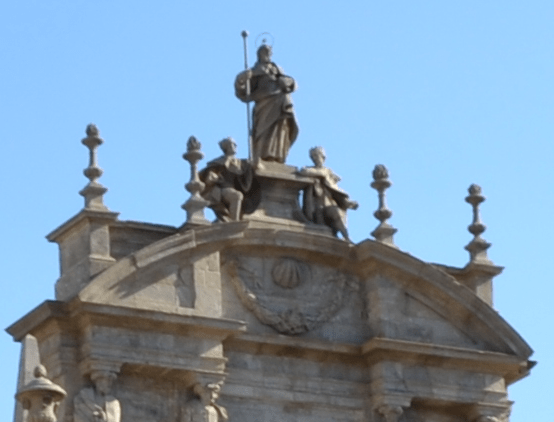
Santiago and Kings Alfonso III and Ordoño II. Close up of the Azabacheríá facade by Sebbe xy, available CC BY-SA 3.0 https://creativecommons.org/licenses/by-sa/3.0, via Wikimedia Commons

As with most of the other façades, its dominated by a statue of Santiago as a pilgrim, and kneeling at either side of him the crowned kings Alfonso III of Asturias and León (848?–910) and his son, Ordoño II of León (872?–924).  Alfonso the Great, as he was known, is historically seen as one of the first significant figures of the Reconquista (‘reconquest’), the gradual Christian takeover of lands ruled by the Muslims in the Iberian peninsula since the early eighth century.  He divided his kingdom between three of his sons, García (León), Fruela (Asturias) and Ordoño (Galicia), and left the cathedral 500 pieces of gold in his will (which García probably pocketed).[1]  One of Fruela’s first actions as king was to journey to Santiago de Compostela to ask the saint’s help for his new responsibility,[2] while Ordoño (who had already ruled Galicia under his father) was also a generous patron of the early medieval cathedral, as he and his wife gave it two chests of gold and thirty-five Muslim prisoners of war.[3]

The job of designing this façade and replacing the earlier Romanesque exterior was entrusted to Domingo Antonio Lois Monteagudo from Pontevedra (1722–85), an architect who shone as a student in Madrid and Rome, but has traditionally been seen as the epitome of a frustrated talent, chafing at having to implement the works of other.[4]  But you would never imagine that, looking at the most architecturally coherent of all the four facades of one of the most impressive medieval-early modern buildings in the world.


[1] José María Manuel García-Osuna y Rodríguez, ‘El astur rey de León Fruela II Adefónsiz “El Leproso”’, Argutorio: revista de la Asociación Cultural ‘Monte Irago’ 20 (2008), 25–8: 25.  https://dialnet.unirioja.es/servlet/articulo?codigo=2501667

[2] José María Manuel García-Osuna y Rodríguez, ‘El astur rey de León Fruela II Adefónsiz “El Leproso”’, Argutorio: revista de la Asociación Cultural ‘Monte Irago’ 20 (2008), 25–8: 26. https://dialnet.unirioja.es/servlet/articulo?codigo=2501667

[3] César Álvarez Álvarez, ‘Ordoño II’, Diccionario Biográfico electrónico (DBe) de la Real Academia de la Historia, https://dbe.rah.es/biografias/7299/ordono-ii.

[4] Enrique Fernández Castiñeiras, ‘Domingo Antonio Lois Monteagudo’, Diccionario Biográfico electrónico (DBe) de la Real Academia de la Historia, https://dbe.rah.es/biografias/22021/domingo-antonio-lois-monteagudo.

Royal Pilgrims

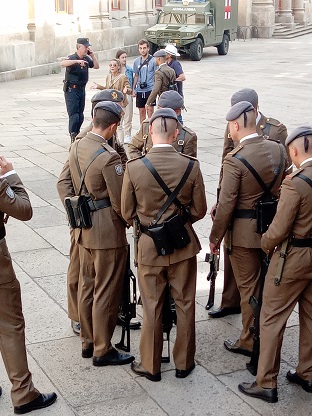
Soldiers in Santiago de Compostela, 25th July, 2022 (image: author’s own).

The last time I was in Santiago de Compostela, it was crowded with Germans, most of whom were named Heckler & Koch.  I could almost hear Malcolm Tucker from The Thick of It in my head swearing that there were enough goons hovering around to stage a coup d’état.  In fact I probably haven’t seen that many guns since I was defending the armoury in Ballymullen or Sarsfield barracks during my late teens in the FCA (Irish military reserve).  It was 25th July 2022, the feast of Santiago, and the cathedral and much of its surrounds were off limits for several hours, as King Filipe VI and his family were visiting.  There were even five soldiers outside the bar on the Rúa de San Francisco where I stopped in for tortilla.  I imagine nobody was going to try a dine-and-dash that day.

The Spanish monarchs make a tradition of visiting the cathedral during Jubilee years (those in which the feast day of Santiago falls on a Sunday), and it got me thinking about why this might be so.  Historically, royal pilgrims’ reasons for journeying were not that different from those of people much farther down the social ladder, which may broadly be divided into two (somewhat self-focused?) categories – asking for help, and acknowledging help received.

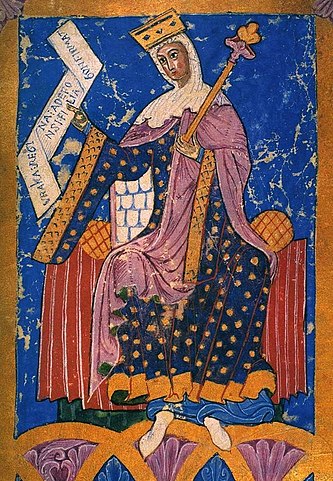
Alfonso II of Asturias (d.842) in the twelfth-century Libro de los Testamentos. Public Domain image available here, on Wikimedia Commons.

The earliest pilgrim to Santiago whose name is known was an early ninth-century king – Alfonso II of Asturias – whose supposed route from Oviedo (modern Asturias) through Lugo (Galicia) is now known as the Camino Primitivo (‘The First/Original Way’).  Alfonso ‘the Chaste’ is a figure of incredible importance for the history of Spain, possessed of deep religious conviction and the first great benefactor of the cult of Santiago.  Perhaps he went to ask for help?  His northern kingdom had come under considerable pressure from military campaigns by Hisham I of Córdoba (d. 796) and his son Al-Hakam I (d.822), but he weathered the storm. People have a tendency to think that modern actions and historical figures are more important than those of the remoter past, but it could easily be argued that in the longue dureé of Spanish history Alfonso II is more significant than Franco.

Fast-forward six hundred years and Isabella of Castile (1451–1504), famous with her husband Ferdinand of Aragon as the ‘Catholic Monarchs’ (Los Reyes Católicos) and sponsor of Columbus’ voyage to the New World, supposedly went on pilgrimage to Santiago de Compostela to pray for an heir.  Their successor as monarch of a newly created/unified Spain was their unfortunate daughter Joanna the Mad (Juana la Loca), who was muscled out of power and kept in confinement for most of her adult life, but who is nonetheless an ancestor of the current kings of Spain. 

Maybe Filipe went to say a prayer of thanks?

Platerías facade

Image by: Lancastermerrin88; no changes made to the original, which is available here (License: CC BY-SA 4.0 https://creativecommons.org/licenses/by-sa/4.0, via Wikimedia Commons)

For many peregrinos, undertaking the Camino and visiting the cathedral of Santiago de Compostela gives them a connection with pilgrims past, and much of their spiritual comfort comes from feeling part of a millennium-long continuum, rather than from visiting apostolic relics.[1]  In this vein, the Platerías facade (Pratarías in Gallego) offers them one of the most ‘authentic’ connections to the medieval pilgrim experience.

The Platerías is on the ‘right-hand side’ of the Cathedral, and it takes its name from the silver workers who had their shops on the square (plata ‘silver’), and for a medievalist it’s almost more interesting than Casas Novoas’ more famous work, because it is the only one of the four facades not to be obscured by early modern structures – what you see is the Romanesque entrance more or less as it was in the twelfth century.

Two doorways dominate the view, although on approach the eye is quickly drawn to the collection of sculpture above them.  At first glance you’d think it looks like an amalgam of rescued reliefs and stray stonework fixed into place rather than being left go to waste, and upon closer inspection you’ll find that you’re right!  It’s believed that a considerable number of the pieces date from the twelfth century and were rescued after a fire in the cathedral and then assembled above the doors, without too much rhyme or reason to their ordering.  So although they may not have been part of the original design, they’re very much of the era.

Detail of a centaur from this image by Luis Miguel Bugallo Sánchez. License: CC BY-SA 3.0 https://creativecommons.org/licenses/by-sa/3.0, via Wikimedia Commons

As ever, the devil’s in the detail.  Winged monkeys like something out of the Wizard of Oz torment souls and show Jesus the riches of the world he could possess, if he bowed down the Satan (Matthew 4:8–11).  A delicious irony for the Silverworker’s Square?   Nestled among the heavenlies and the harlots are classical figures too.  A fragment of a centaur twisting backward to fire an arrow appears to be taking aim at a mermaid over the other doorway (who probably wasn’t his original target).  What are they doing here?  Most likely they’re allegorical figures.  In the middle ages, the halfman-halfhorse centaur frequently represented heretics, whose human front hid their inhuman nature,[2] and Dante made a demon of him, shooting arrows at sinners in a boiling river of blood in the seventh circle of hell.[3]  The classical world provided a frame of reference for much of medieval thinking, and images of classical gods or mythical figures in religious buildings were not blasphemous or ‘crypto pagan’, but rather part of the ‘visual vocabulary’ of artists (sorry to all the Templar nuts out there who think finding a piece of mythological sculpture in a church somehow reflects supposed arcane beliefs and rites).

Overall, the Platerías facade might not catch the eye in the same way as that of the Praza do Obradoiro at the ‘front’ of the cathedral does, but here silver need not mean second place.


[1] Sasha D. Pack, ‘Revival of the pilgrimage to Santiago de Compostela: the politics of religious, national, and European patrimony, 1879–1988’, The Journal of Modern History 82:2 (2010), 335–67.

[2] [Anon.], ‘A Siren and a Centaur about 1270’, J. Paul Getty Museum, available at: https://www.getty.edu/art/collection/object/103SAW (no date).

[3] Antoine Mac Gaoithín, ‘Mythical creatures at the Worth Library: Centaurs’, Edward Worth Library, available at: https://mythicalcreatures.edwardworthlibrary.ie/ancient-world/centaurs/ (no date).

Santiago/St James in the Last Supper

Given that it’s Easter weekend I thought Santiago in the art of the Last Supper might make an interesting post.  When we think of artistic representation of the Last Supper, the first painting that comes to mind is undoubtedly Leonardo da Vinci’s fresco in the Dominican convent of Santa Maria delle Grazie, in Milan.[1]  But can you spot Santiago/St James in it?  Zoom in and give it a shot.

By Leonardo da Vinci – High resolution scan by http://www.haltadefinizione.com/ in collaboration with the Italian ministry of culture. Scan details, Public Domain, https://commons.wikimedia.org/w/index.php?curid=3032252

Can’t find him?  Don’t worry, neither did I.  In much of medieval and renaissance art apostles are recognisable by particular symbols, a kind of visual vocabulary that allowed anyone of any language or no literary ability to identify a statue or painting of a saint.  Peter frequently has a set of keys, Mary Magdalene carries an urn or ointment box, and Bartholomew, who was supposedly flayed alive, even carries his own skin!  Santiago, of course, is frequently recognisable by the shell, broad hat, and pilgrim staff.  But in representations of the Last Supper, these symbols are frequently absent, and it’s hard to identify one apostle from another within a ‘crowd’ of them (is there’s a collective noun for apostles?!).

A few different incidents at the gathering were seized upon by artists over the centuries as their subject, such as the washing of the feet, the initiation of the eucharist, and – in Leonardo’s case – the dramatic moment in which Jesus announces that one of them would betray him.  For renaissance artists who wanted to experiment with representing human emotion, this was an ideal opportunity to depict a variety of sensations: disbelief, anger, incredulity, confusion and resignation.  In Leonardo’s Last Supper there’s a triad of figures immediately to Jesus’ left (our right), where a largely-obscured figure is pointing upwards (possibly ‘Doubting’ Thomas) and the third figure on Jesus’s left (believed to be Philip) seems to be pointing at himself and pleading with Jesus as if to say ‘Don’t say it’s me!’  Identification in this case is possible thanks to notes in Leonardo’s surviving notebooks and sketches.  

By Leonardo da Vinci – High resolution scan by http://www.haltadefinizione.com/ in collaboration with the Italian ministry of culture. Scan details, Public Domain, https://commons.wikimedia.org/w/index.php?curid=3032252

So where is James?  He’s the third figure in this triad, sitting directly to Jesus’s left.  His position – the physically closest apostle to Jesus – is unsurprising, as the gospels indicate he was within the ‘inner circle’ of the disciples (I’ve discussed this here in a history of the Camino).  Decomposition of the painting has made most of his body a blur, but he seems to have open and outstretched hands, his right reaching up toward Jesus’s shoulder and his left almost touching the table.  It’s hard to read his expression, but he appears open-mouthed with eyes downcast.  Is he holding back Thomas and Philip?  Is he shouting ‘Whoa!  Back off guys!’?  Is he remonstrating with Jesus?  Not unlikely, given Jesus had nicknamed him ‘Son of Thunder’ on account of his temper. 


[1] The official page of the museum: https://cenacolovinciano.org/en/museum/the-works/the-last-supper-leonardo-da-vinci-1452-1519

The Cross and the Camino: the Crucifix of Santo Domingo de la Calzada

Crucifix in the cathedral of Santo Domingo de la Calzada (La Rioja). Image by Anxo Regueira López, La Vanguardia (Logroño edition) (17/01/2020)

Apologies to the sculptor and commissioners, but the newly installed crucifix of the cathedral of Santo Domingo de la Calzada in La Rioja (a town I really like and featured previously) – it looks like it was made of Playmobil (a Lego-like product, manufactured in Spain).  It did get me thinking about what a crucifix should look like though, and of course you’ll see many styles from many eras along the Camino.

The earliest Christians did not possess crucifixes, partly because they came from a Jewish tradition of non-anthropomorphic art and partly because crucifixion was still a common method of capital punishment; it might have seemed somewhat shameful or at least distasteful (just as a hypothetical modern religion might not adopt as its symbol the electric chair in which its founder was executed).  It took time.

Early representations of Jesus on the cross depict Him wearing a long robe and leaning out toward the viewer, with bulging eyes.  The emphasis is clearly on His triumph over death.  As time went on, more ‘natural’ representations were developed, with the five wounds more visible and His head tilted to one side.  Of course none of these representations are strictly natural, and all have a message and tell us something of the world of the creators.  Certain liberties are taken, most specifically Jesus’ face is still visible.  Upon death, His head would most likely have flopped down and so the face would not have been visible in the upright manner we are used to seeing.  While dying, or immediately after death, His bowels and bladder would have voided, and a realistic representation would probably show a corpse soiled with faecal matter and urine.  Lastly, the loin cloth probably wasn’t present either.  It’s near-universal presence on crucifixes speaks to our (and not just Christianity’s) complex views on nudity, sexuality and the human body, while simultaneously obscuring the most obvious sign of Jesus’ Jewishness – His circumcised penis.[1]

Gothic crucifix in Iglesia del Crucifijo, Puenta la Reine (Navarra). Image author’s own.

Interesting crucifixes along the Camino Francés include the fourteenth-century Y-shaped cross brought by pilgrims from Germany to Puente la Reine (Navarra).  Crucifixes in the Gothic style from this period are characterised by an emphasis on human agony.  No obvious triumph over death here.  Instead a bruised, bloodied and tortured man.  But it would be a mistake to see this as solely an attempt at Gospel-based realism.  These are expressions of a bruised, bloodied and tortured world — the world of the Black Death/Bubonic Plague.

So where does that leave ‘Playmobil’ Jesus in Santo Domingo de la Calzada?  If art partly reflects the culture that produces it, what does it tell us about the world we live in?  And if its interpretation reflects the worldview of the viewer, what does that tell you about me?


[1] One of the great treatments of early Christianity’s developing views on the body and their social contexts is found in Peter Brown, The Body and Society: Men, Women, and Sexual Renunciation in Early Christianity (1988; new edition 2008).  It is a work of immense learning, beautifully written.

Rattle and hum: the towers of the Obradoiro façade

The Obradoiro façade of the cathedral (Image by Yearofthedragon – Own work, CC BY 2.5).

Following on from my last post on the Obradoiro façade, where we looked at the central portion in particular, let’s now take a little closer look at the sides.  In fairness, as you face the façade, your eyes are drawn to the centre such that it’s sometimes hard to appreciate the two flanking towers that frame the central early modern baroque masterpiece.  Or rather perhaps it’s hard to appreciate them individually, because part of the beauty of Fernando de Casas Novoa’s design is the harmony with which the façade works as a unit. 

The north tower (to the left) and the south tower (right) now stand at 74m in height, and are taller than the central body of the cathedral is long; for most peregrinos they were probably the tallest manmade structures they ever saw in their lives.  The towers were parts of the original Romanesque design of the cathedral; sturdy monumental architecture that could also provide a place of refuge in times of trouble and were probably largely unchanged until the seventeenth century, when a series of interventions began that saw them heightened and altered in decoration.  Individual interventions are hard to spot at a glance, but what you might notice is that the bottom two-thirds of the towers look rather cubic, and then they begin to taper into a design that’s both ornate but quite ephemeral, with space for leaving light, wind and sound flow through.  Tip: If you draw a horizontal line to either side from the statue of Santiago in the centre of the façade, you will see a balustrade (stone railing) on both towers, and this marks the point of change, the point where the lower original Romanesque towers meet the early modern additions.  What are the towers’ functions?  Making noise!

Image: by Fernando – Own work, CC BY-SA 4.0, https://commons.wikimedia.org/w/index.php?curid=108259683

A question for you: what’s the loudest thing you’ve ever heard in your life?  Maybe it was the sound of a jet engine taking off?  Maybe you were at a high-intensity sporting event, like Irish boxer Katie Taylor’s 2012 Olympic gold medal campaign in London, when the decibel level at her first bout reached 113.7  ― above the average human pain threshold![1]  Or maybe you were at a concert by a band whose amps ‘go up to 11’ (you know who I’m talking about).  For most of us, the loudest things we hear are artificial sounds or electronically enhanced.  In the medieval and early modern world, unless you had been in battle, the loudest sounds you ever heard were probably thunder and church bells ― both of which could be signs of disaster.  The bell was the ‘background sound to life in the middle ages’, marking times of day, beckoning worshipers, announcing celebrations, deaths, and invasions (for example, in Britain, church bells were temporarily silenced in 1940 and only to be rung in the event of a German invasion), while as George Greenia and Xosé M. Sánchez Sánchez discuss in the journal Ad Limina, the Camino had its own particular soundscape.

The ratchet (carraca) of the left/north tower of the Cathedral of Santiago de Compostela. Image from La Voz de Galicia (20 March 2015).

In the cathedral of Santiago de Compostela, the right/south tower is the ‘bell tower’ and the left/north tower the ‘ratchet’ tower.  The ratchet (carraca), pictured above, is a giant wooden noise maker, shaped like a cross, that is used in particular during Semana Santa (Holy Week, leading up to Easter).  Ratchets for religious ceremonies come in a huge variety of designs, and here’s an example of a cross-shaped ratchet in action.  Its grating and eerie sound is used on Good Friday to mark the death of Jesus – a solemn and disquieting reminder to the medieval ear that even God had to die.


[1] Laura Bleakley, ‘Ireland’s most successful Olympics for almost 60 years’, BBC News  11 August 2012 https://www.bbc.com/news/world-europe-19205892.  See this table of noise levels and effects, from the Department of Chemistry, Purdue University https://www.chem.purdue.edu/chemsafety/Training/PPETrain/dblevels.htm.

The front of the Cathedral of Santiago de Compostela – the Obradoiro façade

The Obradoiro façade of the cathedral (Image by Yearofthedragon – Own work, CC BY 2.5).

It’s the one in all the postcards and selfies, and anyone who has walked/cycled that far has almost certainly had their moment immortalized in pixels and probably taken a few photos for others too. Everybody say ‘Quesoooooo’!

The western façade of the cathedral was the brainchild of Fernando de Casas Novoa, who began construction in 1738 – yes, it’s only two-hundred-and-something years old. Casas Novoa was presented with a particular challenge. The two towers were already in situ, as was the double staircase leading up to the Pórtico de la Gloria, which had suffered over a half a millennium of weathering. Many an architect would have torn down and reshaped what didn’t suit them (St Peter’s anyone?), but Casas Novoa showed his genius by protecting, uniting and enhancing what he found. For those of us not trained in architecture or historic buildings, there is nothing to make the Obradoiro facade seem disjointed or the result of multiple periods of work.

Casas Novoa began at the bottom with a Roman triumphal arch, within which the structure of the double doorway evokes the sword-cross of Santiago. As we move upward we see a large window. Nothing too spectacular, right? Wrong! Remember this was the 1730s, and this window was one of the largest glass structures built prior to the industrial revolution. It allowed the light to penetrate the Romanesque rose window behind it and light up the interior of the cathedral.

Onward and upward! And that’s the point. Casas Novoa created a symmetrical and pyramidal structure that draws our eyes upwards. Above the window is a wreathed sculpture of Santiago’s tomb, flanked by statues of his disciples, Athanasius and Theodore, and crowned by a statue of the man himself, in pilgrim garb and two Spanish kings at his feet.

All in all, harmonious baroque architecture at its best – if you want proof, dig into your pocket. If you find a Spanish 1c, 2c or 5c coin, what do you see on the national side? Not a king, but a crowning piece of architecture.