My article “Remembering and forgetting the Kerry dead of the Spanish Civil War” was published in The Kerryman (online 8th November 2025; print 12th November 2025).
A PDF of the unedited text, as submitted, is available for download here.
Writer, Educator and Occasional Wanderer

My article “Remembering and forgetting the Kerry dead of the Spanish Civil War” was published in The Kerryman (online 8th November 2025; print 12th November 2025).
A PDF of the unedited text, as submitted, is available for download here.
As Christmas rolls around and Camino kids get excited at whether Santa Claus or the Reyes Magos will leave a pair of hiking boots in their stockings, a few might notice that the Christmas period also sees the feast of Santiago/St James. Some of you will have enjoyed the celebrations of the feast of Santiago in Santiago de Compostela and say, “Hang on, isn’t that 25th of July?”, and you’d be right. But he has another one, 30th of December.
Most saints’ feast days fall on the anniversary of their death, with a very few notable exceptions, such as John the Baptist, whose feast falls on the 24th of June. According to the Gospel of Luke, at the annunciation the archangel Gabriel told the Virgin Mary that her cousin Elizabeth (John’s mother) was already six months pregnant, and so the feast of John’s birthday falls six months before Christmas.[1] (His beheading is also remembered on the 29th of August). However, Santiago’s second feast day is that of his translatio or ‘translation’.
The translatio is the formal movement of a saint’s relics from one place to another (usually its final resting place/cult centre), frequently accompanied with elaborate religious rites. While often a formal process, sometimes it was just plain theft, as in the case of St Nicholas of Myra, whose relics were stolen by Italian merchants in the late eleventh century and brought to Bari in southern Italy. They used the classic relic-stealing excuse that if St Nicholas had wanted to stay, then they wouldn’t have been able to take him; his passivity was acquiescence.[2] In many respects, the translatio was a one-off mirror of pilgrimage, for just as the people travelled to the holy through pilgrimage, so the translatio was the holy travelling to the people; it was the movement of the saint’s relics to somewhere they would be more accessible to the populace.
Santiago’s translatio is celebrated on the 30th of December, and as such it commemorates the movement of his body from Jerusalem (where he was martyred) to his resting place in Santiago de Compostela. However, feast days of saints have been known to change over the centuries, and it appears that the movement from the Mozarabic Rite (the liturgical rite of the Christian Church of the Iberian peninsula) to the Roman Rite, during the eleventh and twelfth centuries, saw a change in the celebration of Santiago’s feast. The Mozarabic Rite had kept 30th of December as the feast of his martyrdom, but with the adoption of the Roman Rite under French influence in the cathedral of Santiago, his feast day was displaced to 25th of July and the 30th of December became a subsidiary feast.[3]
[1] Luke 1:26–38.
[2] Jonathan Sumption, The Age of Pilgrimage: the Medieval Journey to God (1975, rev. ed Mahwah, NJ, 2003), 38–9.
[3] Catherine Saucier, ‘Voices of Thunder: Sounding Nature and the Supernatural in the Legends and Liturgy of St James the Greater and St John the Evangelist’, Religions 16:11 (2025), 1–27: 5. Available at: https://doi.org/10.3390/rel16111385.

Since literacy levels were low in the middle ages, artists used a variety of iconographic means to communicate to their audiences, not least to help the viewer identify the subject of their works. Saints, in particular, were recognizable by how they dressed and by items associated with a defining event in their lives or their deaths. St Peter almost inevitably holds a pair of keys, in reference to the occasion when Jesus’ promised him the ‘keys of heaven’,[1] and St Paul bears the sword with which he was supposedly beheaded. More striking examples include St Agatha of Sicily, who presents her severed breasts on a platter. The Sicilians subsequently honoured her with an erotic pastry, the Minne Di Sant’ Agata, with a cherry on top.

Santiago/St James the Great is unusual in that he is normally depicted in one of two guises — peregrino (‘the pilgrim’) or Matamoros (‘the Moorslayer’) — both of which aren’t connected with his earthly life or death. Here I’m going to touch on his peregrino incarnation.
Perhaps uniquely among Christian saints (and certainly among the major saints of the early church), Santiago is often depicted in the guise of one of his followers, the pilgrims who travel the Camino de Santiago. To my knowledge, no other saint is normally sculpted or painted to look like those on pilgrimage to his/her tomb. In his classic form, Santiago peregrino is identifiable by his broad-brimmed hat, staff, scrip (leather satchel) and scallop shell. It is a confection of artefacts that only developed gradually, and early depictions of him as a pilgrim often lack one or more of these (e.g. in the fourteenth-century statue of Santiago in the church of Santiago in A Coruña he is bareheaded).[2] Only from about the fourteenth century does Santiago regularly bear all the accoutrements of a medieval pilgrim. As an added twist, the popular French saint San Roque, is usually shown dressed as a peregrino bound for Santiago de Compostela, with a dog at his side and hitching up his tunic to display his ulcerous leg.
Of course, images are not simply stylised but also fossilised. And if one were to apply the principle that Santiago should be depicted like those who travel to his tomb, then he should probably be wearing lycra, bearing a rucksack, covered by a poncho and using carbon fibre poles… you know, he should look just like you!
[1] Matt 16:19.
[2] Bernadette Cunningham, Medieval Irish Pilgrims to Santiago de Compostela (Dublin, Four Courts Press, 2018), 89–91.

A while back I was asked to pen a tribute to John Brierley (1948-2023), for the Camino Society Ireland. He was the author of the most significant set of guides to the Camino in the English language (I discussed the maps in them previously) and a key figure in the modern history of the Camino in the English-speaking world. That tribute may be found here on the Camino Society Ireland website, or by clicking the portrait image above.
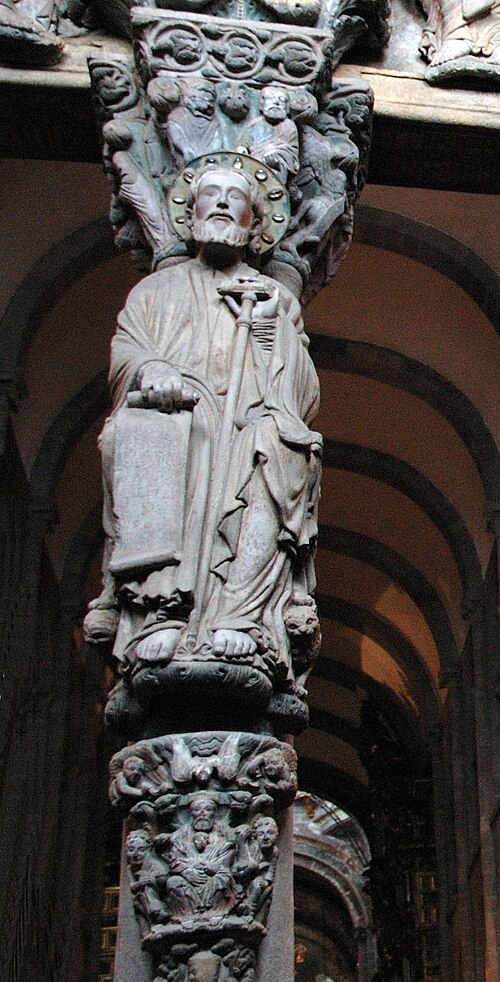
What is ‘authentic’ on the Camino? It’s a word that gets bandied about a lot but — having recently looked at the Pórtico de la Gloria app (available to download here) — I want to put a thought out there. Speaking as a medieval historian, I have no problem saying that the Pórtico is the single greatest collection of Romanesque sculpture in the world, and what is more, it is still in situ. Naturally, after eight centuries of facing Galician weather, it has seen its good and bad days, and has been subject to various interventions, most recently a 12-year conservation project financed by the Fundación Barrié, which ran between 2006 and 2018. The conservation project appears to have been undertaken with unprecedented thoroughness, and a feature on it in the ever-interesting RTVE programme La Aventura de Saber can be found by clicking here. The project’s investigations and activities prompt the question, what is it to be ‘authentic’?
The Pórtico has experienced various interventions, including additions to its ensemble (e.g. the nimbus/halo with crystals over Santiago in the central mullion (pilar)) and repainting in the Early Modern period that rouged up a few of the cheeks in the style of the time (comparable with the angels that hold up the canopy over the high altar inside). Would a conservationist be justified in removing the halo or the paint? You might argue that they would, as these were later additions, but if chronology is the yardstick for authenticity, when — or more importantly how — can we set a cut off date? The sculpture of Santiago has bourn that jewelled halo for more than half its existence and the prophets their face paint; more pilgrims have seen them with these than without them. They have become part of the fabric of the Pórtico.
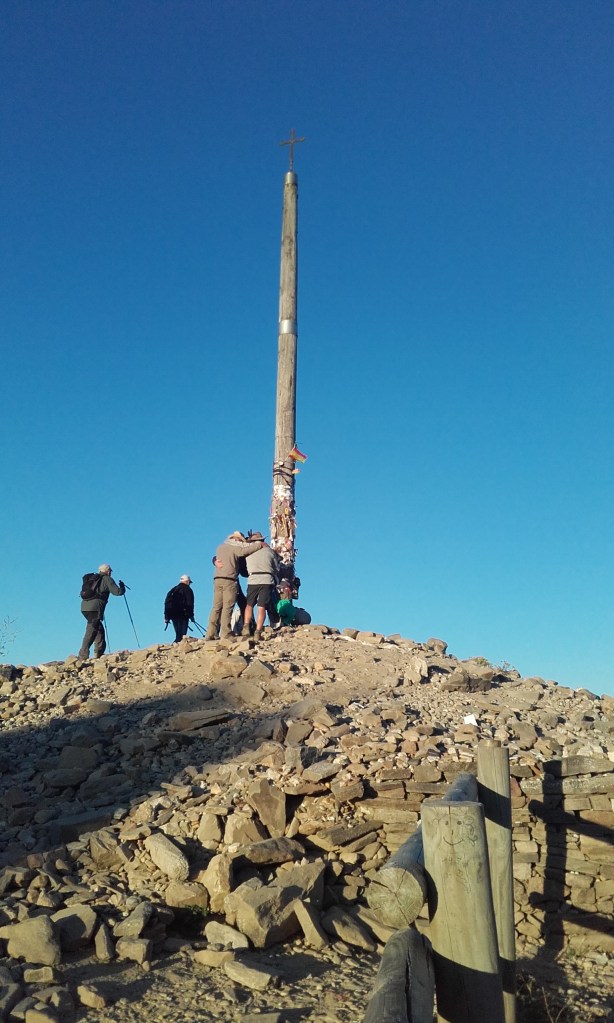
The danger lies in conflating ‘authenticity’ with ‘originality’. Just because something was not there the first day, it does not mean that it does not belong. The Cruz de Ferro (Iron Cross) to the west of León marks the highest point on the Camino Francés, yet to my knowledge was only erected in the 1950s. Does that make it inauthentic? For many, it is a deeply symbolic and emotive feature of their/the Camino. In 2023, I had the pleasure of meeting Len McDonald from Canada, a seasoned peregrino and man with great life experience, who was on a mission to deposit a portion of his brother’s ashes there, and swore to buy a glass of good whiskey for everyone to toast him afterwards. Sadly, I was ill for a couple of days and didn’t meet him, but before I made Santiago de Compostela I raised a glass in absentia, and nobody can tell me that those experiences connected to this 1950s monument were inauthentic.

When you walk into the great cathedrals like those of Burgos, León or Compostela, it is easy to focus on the spectacular, like the Chapel of the Constables in Burgos, the stained-glass ensemble of León, and the high altar of Santiago de Compostela. Quite often these are architectural, artistic and spiritual gifts of later eras, but most of these buildings also contain modest vestiges of their early days, a common example being the presence of consecration crosses.
By the eleventh century, the rite of consecrating a cathedral (dedicating it as a place of worship) had become quite complex, and part of it included the presiding bishop anointing the interior of the building, by marking a cross with chrism (holy oil) twelve times on the walls.[1] This act was often memorialised in paint or stone, as in the case of the consecration of the cathedral of Santiago de Compostela by Archbishop Pedro Muñiz in 1211AD — 136 years after construction began. Cathedral-competitive Catalans might point out that even the Sagrada Família in Barcelona reached this point quicker, as it was consecrated by Pope Benedict XVI in 2010, 128 years after the foundation stone was laid. However, Galicians might retort that at least theirs was finished.
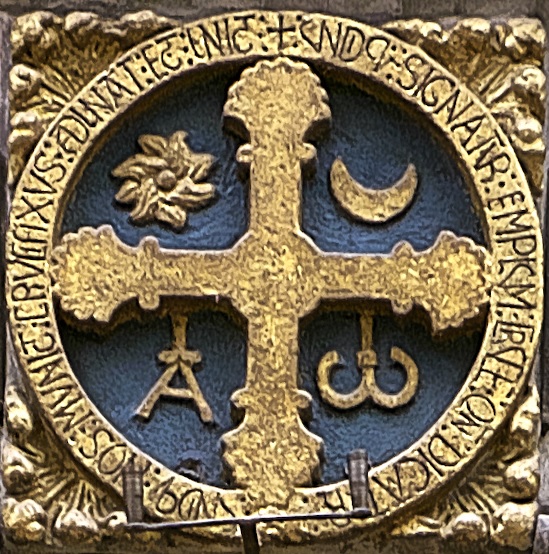
In Santiago, the twelve consecration crosses are works of stone, consisting of a cross within a circular belt, with an alpha and omega hanging from its arms, and a sun and moon occupying the spaces above them. Each belt contains an inscription, either recording the date of consecration or relating to an aspect of the ceremony. Although some were moved over the centuries, due to new construction works within the cathedral, over half are still in their original locations on the interior walls and bear witness to 800 years of Camino history.
[1] Vincent Debiais, ‘Writing on medieval doors: the surveyor angel on the moissac capital (ca. 1100)’, in Irene Berti, Katharina Bolle, Fanny Opdenhoff and Fabian Stroth (eds), Writing matters: presenting and perceiving monumental inscriptions in Antiquity and the Middle Ages (de Gruyter, Berlin, 2017), 285–308: 295.
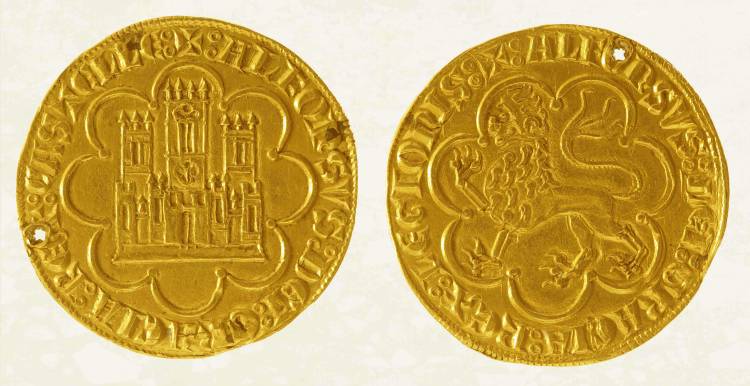
The euro, SEPA (Single European Payments Area), Revolut — they’ve all made paying for things on the Camino a lot easier in recent years. It’s not that long ago (only a little over twenty years) that a pilgrim would still have had to go to their local bank and put in an order for pesetas before travelling. Calculations would have to have been made about how much was necessary per day for accommodation, food, etc. on the basis of dubious information (probably by chatting to a Camino-know-it-all like myself), a wedge of notes might take a while for the bank to obtain, and it had to be husbanded over the course of the journey. In some respects, the medieval or early modern situation was not that much different.
Depending on their starting point and route, a pilgrim might have to travel across several kingdoms, each with its own coinage (no notes), which was nigh-on impossible to obtain in advance. When moving on, they had to be conscious of not being lumbered with coinage that would be impossible to exchange and essentially represent lost money. A pilgrim often carried the entire sum of their return journey with them and accident, theft, or bad luck at cards or dice, could leave even a well-to-do pilgrim reliant upon charity. Some pilgrims ran up bills and did a ‘dine-and-dash’ (or what would probably be a ‘dine-and-hobble’ on the Camino), like the infamous Gerald of Wales, who for all his chauvinistic self-righteousness proved himself to be nothing more than a thief when he high-tailed it out of Rome in 1203, with a string of creditors behind him pursuing him all the way to Bologna.[1]
As Jonathan Sumption has observed, from the fourteenth century onwards the life of a wealthy traveller became easier, with the development of international banking systems, such that pilgrims could obtain bills of exchange and hoteliers on certain pilgrim routes acted as bankers of sorts.[2] Certain coinage systems became more widely accepted, and within the Iberian peninsula Castilian coins — many of which were based upon the coinage of Al-Andalus (Muslim Iberia) — were probably accepted generally. Regardless of how well a pilgrim managed their finances, it could still be an expensive enterprise. It has been estimated that the cost of travelling from Scotland to Rome in the middle of the fifteenth century was the equivalent of the annual income of a well-to-do knight (£66 sterling or £200 scots), but passage on a ship from Ireland to Spain on a Jubilee Year during the same period might cost as little as 7s 6d, making it a vastly more affordable option and opening up pilgrimage to people a lot less wealthy.[3]
For today’s pilgrim, the move to a cashless economy needs to be treated with caution out of consideration for those operating the Camino infrastructure. Very few albergues/hostels have electronic payment systems, and the few remaining donativos (whose generosity is being stretched to breaking point, causing many to abandon the donation system) are particularly vulnerable. A few notes in your wallet won’t weigh you down, but may lighten their load considerably.
[1] Jonathan Sumption, The Age of Pilgrimage: the Medieval Journey to God (Mahwah, New Jersey, 2003), 291–2. (Originally published as Pilgrimage (London, 1975)).
[2] Ibid., 292–3.
[3] Bernadette Cunningham, Medieval Irish Pilgrims to Santiago de Compostela (Dublin, 2018), 20 and 113. Bearing in mind that the 7s 6d probably only got you the right to sleep somewhere on the ship’s exposed deck and covered none of the rest of your expenses.
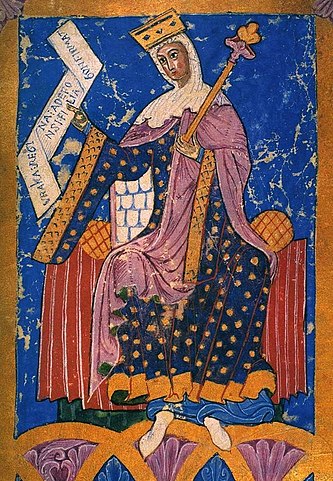
Hello to Kate and her Crew on the way to Santiago!
I thought a post on the work of a strong woman would be eminently appropriate, and who better than Urraca, Queen of León, Castile and Galicia (1081–1126) — a prudent and modest Jezebel possessed of good sense (in the mixed judgement of Diego Gelmírez’s Historia Compostelana).
In a time when females ruling in their own right was essentially unknown, she was ‘Empress of All Spain’, and as the only legitimate child of King Alfonso VI (‘the Brave’) of León and Castile, the already widowed Urraca inherited his lands in 1109. She was forced into a second marriage with Alfonso I (‘the Battler’) of Aragón and Navarre and civil war broke out in Galicia, with the fractious nobility promoting the right of her young son from her first marriage to rule (not necessarily a sexist move, but probably because they hated the Aragonese). She was initially backed by the militarily adept Archbishop of Santiago, Diego Gelmírez/Xelmírez — ‘Santiago’s Catapult’ — although he flipflopped (an essential figure in the development of the cathedral at Compostela). War with her cruel husband also followed, and in her fight against him she counted as allies and lovers some of her kingdoms’ most significant nobles. Although the peace saw her lose some Castilian territory, essentially she won the right to be recognised as de jura queen, with the ability to transmit her crown to her own heirs.
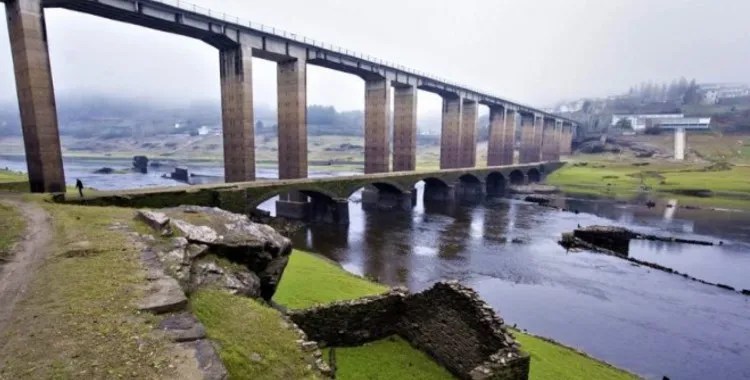
According to the twelfth-century Pilgrim’s Guide, Urraca had the bridge over the river Miño at Portomarín destroyed during her war against her husband. Further destruction was caused by the damming of the river to create the Belesar reservoir in the late 1950s, although most of the town was moved to higher ground, including notable buildings like the Order of St John’s fortress-like Iglesia de San Juan. From the modern bridge over which you pass on the way into the town you may see (if the water level is sufficiently low) the remains of that Roman bridge below.
If you want to toast Urraca, Portomarín holds a celebration of its local liquor— the Fiesta de la Aguardiente. It comes in a variety of flavours, including unleaded and premium.
As next Tuesday (23rd April) is St George’s Day (San Jorge), I thought one of Spain’s favourite saints deserved a look in. Naturally, he has some competition. But St George vs St James — no contest, right? Well, as ever it depends from where you’re looking, especially if you’re on the Camino Aragonés or Camino de Levante.

The common equestrian image of Santiago as Matamoros (The Moorslayer) depicts him descending from the sky at the alleged Battle of Clavijo (844) to save the army of Ramiro I of Asturias from vastly superior opposing Muslim forces. From then he became a patron of the Christian kings of the north in their so-called Reconquista (the (re)conquest of the Muslim-controlled lands of Iberia in the Middle Ages). Or so that’s how the later story goes. The battle may never have taken place and the story seems to date from the twelfth century (i.e. after the pilgrimage to Compostela had already gained traction). Meanwhile Saint George (San Jorge) had supposedly appeared at the Battle of Alcoraz (1094–6) to help Pedro I of Aragón and Navarra to take the city of Huesca (a city in modern Aragón) from the Muslims. If Santiago was the patron of the Spanish and an active promoter and implementer of the Reconquista, then why wasn’t he there to help Pedro?
That two different saintly patrons are depicted engaging in the same activity is not unusual, but in this case it points to the Reconquista not being a unified event or process, and to the evolving rivalry between the kingdoms of Aragón and Castile (which by the eleventh century incorporated Asturias), the two great powers of the Iberian peninsula. In fact, the crown of Castile fought alongside the Muslim forces against Pedro I at the Battle of Alcoraz!

Modern Spain is essentially the fusion of the crowns of Castile (the largest of the Iberian kingdoms by landmass) and Aragón (a substantial Mediterranean power), following the marriage of Isabella of Castile and Fernando II of Aragón (they who patronized Columbus’ voyages and built the Hospital de Los Reyes Católicos on the Plaza de Obradoiro in front of the cathedral of Santiago de Compostela). That Santiago became the patron of Spain rather than George, is as much the triumph of Castile over Aragón, as it is of the Christian princes of the north over their southern Muslim neighbours.

The history of the Quintana façade is that of a cover-up, and I mean that literally, not metaphorically — after all, the historical links between the square and fascism are still openly on display, and that is an issue that many places on the Camino have sought to remove from memory. Instead, this cover-up is a physical one.
Owing to a variety of additions over the centuries, the east end (‘back’) of the cathedral had a acquired a fairly irregular shape and in the seventeenth century it was decided to tidy it up and give it a uniform appearance. Thankfully, rather than engage in massive architectural alterations to the various chapels, Canon José Vega y Verdugo commissioned a baroque-style stone curtain wall to stand in front of them. That wall contains four doorways with connecting passageways to the Cathedral, which can best be appreciated from the excellent rooftop tour of the cathedral. Now let’s see behind Door Number 1!
Actually, no, we won’t, because we’re not allowed in there. At least not this year. The Holy Door is only opened on Jubilee Years i.e. those years in which the feast of Santiago falls on a Sunday; the next one is 2027 (although I’d swear I took the above photo in 2019, which wasn’t a Jubilee year). It’s recognisable by the iron gate across it, and like the Obradoiro entrance at the polar opposite side of the cathedral, the Holy Door is designed to look like a Roman triumphal arch — a militaristic celebration of the cult of Santiago.[1] It’s crowned by a statue of Santiago dressed as a pilgrim and he’s flanked by smaller statues of two of his disciples, Athanasius and Theodore by the sculptor Pedro del Campo (1694). Below them, on either side of the door are two sets of twelve stone figures (representing apostles and Old Testament personages), which derive from the now-demolished stone choir that Master Mateo had constructed within the cathedral.
For many the Quintana is a chill-out square, with cafes at both ends and a place to catch up with people now that the walking is finished (and, as I found in 2022, the perfect place to listen to the All Ireland final online). But the Quintana itself is unfinished. If you look at the highest point over the Royal Door you’ll see an inscription D. O. M. TOTIVS HISPANIAE PATRONO ET PROCECTORI SACRVM 1700 (‘To God, most good, most great; Holy Patron and Protector of all Spain 1700’). Above it stands an empty pedestal, perhaps a reminder that like the Quintana façade, your Camino is not yet done.
[1] Daniel Caruncho (trans. Cerys Giordano Jones), Santiago Cathedral (Dosde Publishing, Barcelona, 2017), 56–9.
Have a WordPress.com account? Log in now.

