The Camino and the Spanish Civil War (part 1)

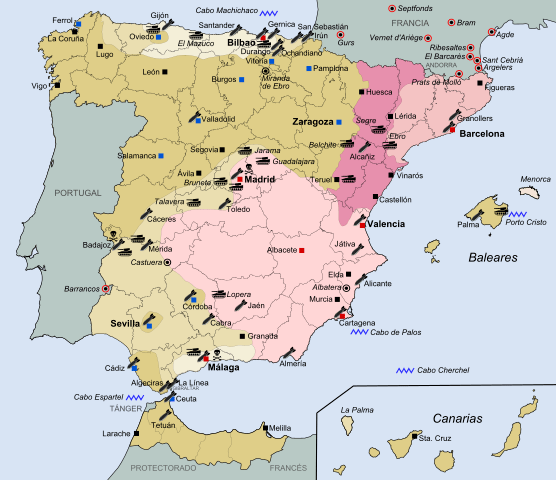
General map of the Spanish Civil War (1936–39)
By FDRMRZUSA, CC BY-SA 4.0, https://commons.wikimedia.org/w/index.php?curid=75214857

You might not notice it, but the Spanish Civil War (1936–39) is a conflict still alive in Spain.  Any Spanish person you meet of 60 years or older (e.g. some of the hospitalero who run the albergues you stay in) will not simply be old enough to have lived under the dictatorship, but will have started to become politically/socially conscious at that time (Franco died in 1975).  Almost every family will have memories, every community semi-repressed memories, and both inherited hatreds.  Political parties have inherited stances and in some cases are direct descendants of older groupings (e.g. the PP – last in government 2018 is the direct heir of the Francoists, though Vox is perhaps a closer ideological heir).  And yet for most of us pilgrims, we are aware of the conflict mainly through the tragic artistic masterpieces it inspired – Picasso’s Guernica, Hemingway’s For Whom the Bell Tolls, Orwell’s Homage to Catalonia and Sender’s Réquiem por un Campesino Español (‘Requiem for a Spanish Peasant’) to name but a few.  But what has this to do with the Camino?  Perhaps more than you think.

Firstly, the outbreak of rebellion by right-wing elements in the Spanish army (led by Generals Sanjurjo, Mola and Franco) in 1936 was followed by rapid territorial gains in parts of Spain.  Some areas declared for the rebels with hardly a shot fired, and those areas along the Camino Francés — parts of modern Navarra, La Rioja, Castille y León, and Galicia — went with the rebels almost instantly (the dark brown areas on the map).  This is not to say that they were spared the horrors of war.  Oh no.  The rule of terror began and continued for a long time, with even the possession of a labour union membership card enough to put you in danger of being shot.  But those areas were spared the damage to churches and ecclesiastical property that happened in other areas, either through military action or the over-flowing frustration of many ordinary Spaniards by whom the Church was viewed as an institution of the elite and an organ of oppression.  Consequently, many of the riches of the Camino that you visit may well owe their survival to being on the ‘right’ side of the line when the Francoists rebelled.  I will provocatively propose that the modern ecumenical Camino is an unwitting legacy of Spanish fascism.

In a series of blogposts, I want to explore the Civil War on the ground, following the route of the Camino Francés, beginning in Navarra, by looking at things like events that happened at individual Camino locations, placenames, and execution and burial sites.  These posts will be broken up by others, but the civil war posts will be numbered, and you can use the labels to follow them.  For those of you who are interested in reading more about the war in general, I recommend the works of Paul Preston, perhaps the greatest historian of modern Spain in the English language, in particular his The Spanish Civil War: Reaction, Revolution and Revenge (2006).  We’ll begin in a future post in Navarra, and the reminders embedded in the streets of Pamplona.

Compostela — ‘Field of the Star’?

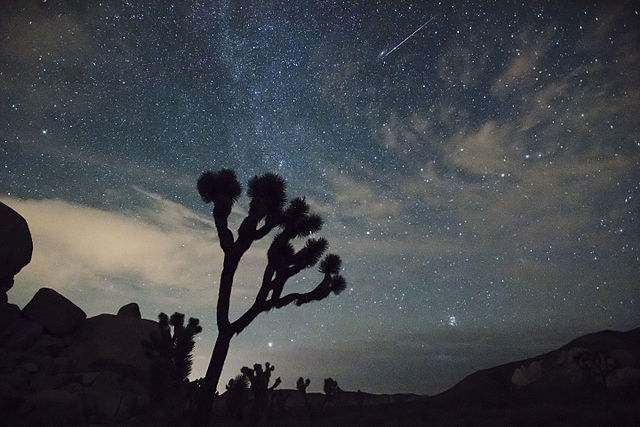
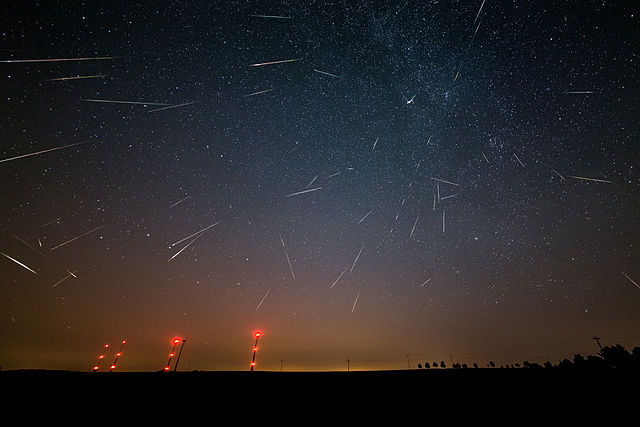
By Joshua Tree National Park – Perseid Meteor Shower; 8/11/15, Public Domain, https://commons.wikimedia.org/w/index.php?curid=44122793

In a previous post I mentioned seeing the Perseid meteor shower about halfway between Burgos and León and it got me thinking about the origins of the name Compostela, which some suggest comes from the Latin Campus Stellae ‘Field of the Star’.

Etymologies — the origin and explanations of names — can be fun.  For example, my name is Denis, which comes from Dionysius, the name of the Greek god of wine and debauchery (clearly my parents are far-sighted people), and until recently I lived in a county called Westmeath, which is… well… west of Meath.  Sometimes you don’t need a degree in advanced linguistics to work with etymologies.  Anyway, Compostela has been etymologised as deriving from Latin campus (‘field’) and stellae (‘of the star’).  This might be an example of what is known as a ‘folk-etymology’, where a name is believed to derive from well-known and common elements, when it actually derives from older and obsolete words, which are then replaced by modern and more readily comprehensible forms.  In the case of Compostela, its name may originally come from compostum, meaning a burial place (think garden ‘compost’), but there are other suggestions too.  The form Campus Stellae is associated with the tale of a hermit named Pelayo, who in 813AD supposedly saw a star hovering over the spot where the long-forgotten saint’s tomb lay.[1]

It would be easy to play the credulous historical detective and suggest that there really was a Pelayo who witnessed the Perseid meteor shower, and this led him to identify the site of what he thought was Santiago’s tomb.  However, linking the discovery of a forgotten saint’s tomb to a heavenly sign is a trope of medieval literature, and of course it has good biblical precedent, in that the Magi are said to have located the site of the nativity by following a star to Bethlehem, also from East to West.  Whether the story led to the folk etymology or the etymology to the creation of a story to explain it is very much chicken and egg.  But by the same token, hyper-scepticism should not prompt us to throw the baby out with the bathwater.  Medieval Christianity held that observing the motion of heavenly bodies, whose movements were regular, offered a glimpse of the sublime.  The constancy of the stars was a blueprint for God’s plan for creation (rather like Javert saw in Les Misérables), and when something out of the ordinary occurred — like a meteor shower — it could be interpreted as a sign for good or ill.

The Perseid meteor shower is a series of tiny particles trailing off the comet Swift–Tuttle, and is so called because it looks like they are coming from the constellation of Perseus (but there is no connection with it; this is just an earthbound perception).  This year it’ll be at its most visible on the 11, 12 and 13 of August, when you might see up to 40 or 50 meteors an hour at its peak.[2]  Within Ireland one of the best places to view it is southwest Co. Kerry, an area of extremely low levels of light pollution and home to the Kerry International Dark-Sky Reserve.[3] Or just stay outside, look to the sky, and see where it takes you.


[1] Oxford Reference, ‘Santiago de Compostela: Overview’: https://www.oxfordreference.com/view/10.1093/oi/authority.20110803100441348

[2] https://earthsky.org/?p=165416

[3] Wikipedia, ‘Kerry International Dark-Sky Reserve’: https://en.wikipedia.org/wiki/Kerry_International_Dark-Sky_Reserve

Know your Camino architecture: Romanesque and Gothic

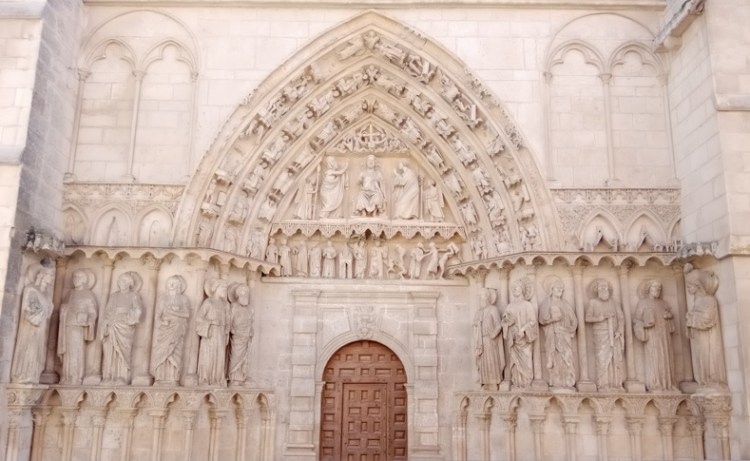
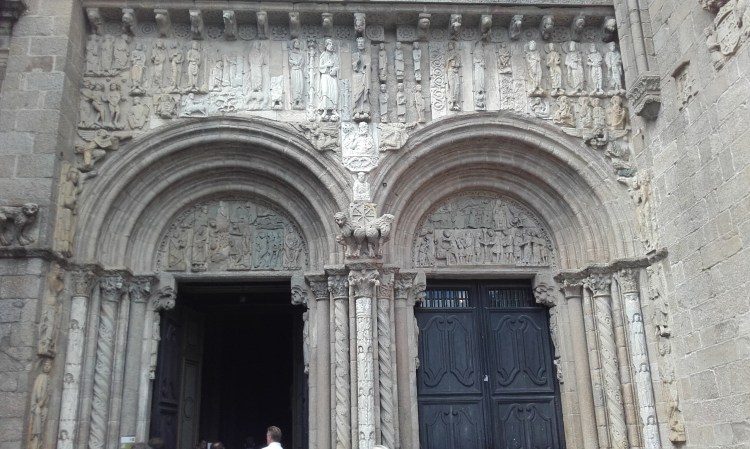
Romanesque doorway of the cathedral of Santiago de Compostela (image: author’s own)

Do you have a favourite type of medieval architecture?  Weird question?  Personally, as a medieval nerd I’m a bit torn between Romanesque and Gothic, but I think the older Romanesque wins out.  Why?  Well firstly it comes down to what they can and can’t do.

Romanesque and Gothic are readily identifiable by their trademark arches; the rounded Romanesque and the pointed Gothic.  But it’s more than a question of style, as each has different capabilities, even if an arch is essentially just a device for supporting something heavy, like a road or roof.  Romanesque arches and Romanesque barrel vaults (ceilings that look like one long semi-circular arch) are rounded and they push heavily down and outwards, requiring sturdy walls to hold them up.  Internally, a building like a large church or cathedral might have a several parallel barrel vaults, usually a big one down the centre and a smaller one on either side.  The large central vault pushes against the two side vaults, while they push back on it in turn, meaning that the internal support walls don’t have to be too big because they don’t have to take all the pressure alone.  However, the buildings still need thick and imposing external walls, and the taller the building, the thicker the walls must be.  It’s also not easy to break a window through such thick walls and so Romanesque buildings would naturally have been darker than they appear to us today under electric lights.  I sometimes think it’s a shame that we lose the interplay of light and dark and the race of shadows from flickering candles that would have been so natural to the interior of these buildings prior to the twentieth century.

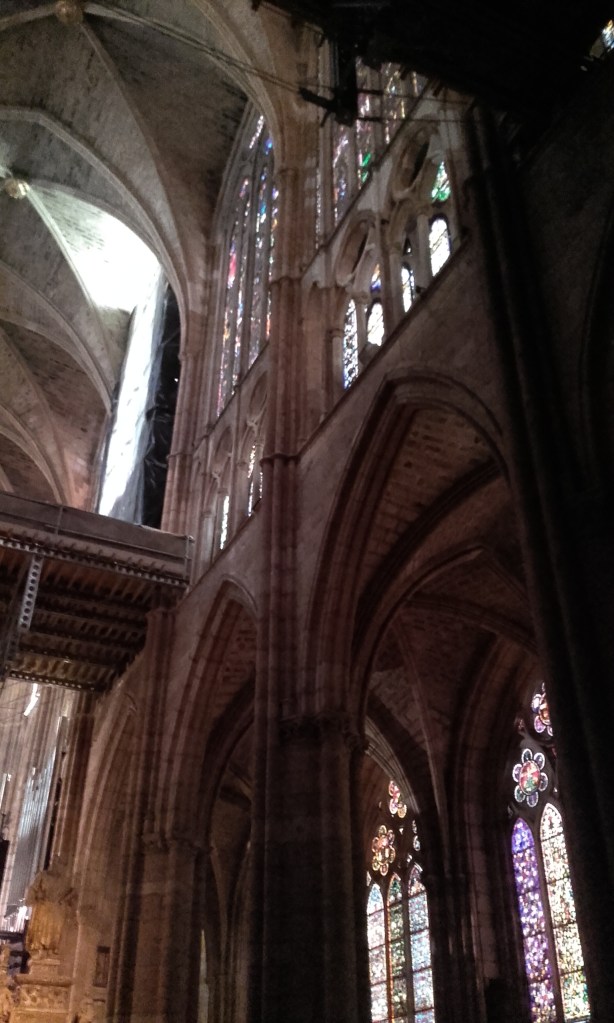
Gothic architecture evolved from Romanesque during the twelfth century and is easily recognizable by its pointed arches.  These were combined with rib vaults (ceilings with crisscrossing ribs between the arches) to produce an architecture with a whole new set of possibilities.  Ceilings could be lighter, and buildings could be made taller without the use of enormous volumes of stone.  Most spectacularly from an aesthetic point of view are the windows — the greatest gift of austere Gothic architecture is light!  A window is a structurally weak point in a wall, but in Gothic buildings the walls could be made much lighter and windows broken through with greater ease.  There is no better example of this on the Camino than the cathedral of León, where its beautiful stained-glass windows flood you with inspiring colour.  When Pope John XXIII visited, he was said to exclaim in admiration, “This Cathedral has more glass than stone, more light than glass and more faith than light!”[1]  I can’t imagine a more perfect tribute to its builders.

León – a gothic cathedral of light (image: author’s own)

When I finally entered the cathedral of Santiago de Compostela on an August evening in 2016 after walking 52km that day (a long story for another post), I had a little nerd-gasm — after expecting another Gothic cathedral of light I looked up and saw its magnificent and subtly lighted Romanesque barrel vault, and I knew in an instant it would always be one of my favourite buildings.

Do you have a preferred style or building, maybe along the Camino?  Feel free to post a note below!


[1] ‘Pulchra Leonina, The Gothic Cathedral in body and soul’, https://www.revistacatedraldeleon.es/pulchra-leonina-the-gothic-cathedral-in-body-and-soul/

Eucalyptus — a (un)welcome smell on the Camino?


By Martin253 – Taken by Martin253, Public Domain,
https://commons.wikimedia.org/w/index.php?curid=1887799

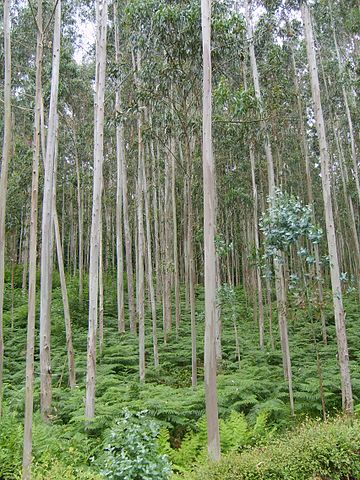
Eucalyptus is one of the smells I associate with the Camino, particularly stretches of the Camino del Norte/Primativo, and while I enjoy the sweetness that fills the air as its thimble-like seed capsules crunch underfoot in the early morning, I can’t help but wish it wasn’t there. Perhaps that’s because one interloper rarely likes another?

Eucalyptus is native to Australia and like most gate crashers it just can’t hide what it is. It’s tall and slender, bare at ground level before its branches start high in the trunk, while its pale grey leaves are like nothing else in the landscape — you can spot a cluster or even individual trees from across a valley. Alongside its seed capsules, the ground around it is usually strewn with the bark it sheds annually, peeling off in great slivers like burnt Irish skin in the Spanish sun.

It’s also almost designed to be fire hazard. The chemical composition of the great accumulations of dried bark stop it from rotting easily, but it certainly lights up without too many problems, while the leaves’ oil content only adds to its flammability. On top of all that, the large volume of water it soaks up make ground conditions much drier than they would otherwise be. Native oak and pine forests can survive small grass fires but when a eucalyptus plantation goes up in smoke it takes everything around with it, as has become increasingly clear in recent years in Galicia, like 2019 when forest fires cut off roads and forced the evacuation of a number of villages.

What is it doing in Galicia? In large part it’s another unfortunate legacy of the Franco era. The combination of warm weather and high-rainfall make particularly good growing conditions for this water-guzzling friolero, and so it was planted in great swathes, primarily to produce wood pulp. The downside, even without creating situations that would make Red Adair weep, is that it has crowded out many of the native species like Holm Oak and the pines that inspired the Galician regional anthem, Os Pinos (‘The Pines’).1 A knock-on effect is that it has also affected the web of creatures that live on and with the older resident species, whether it be birds that nest in them, mammals that live among their gnarled trunks and roots, or those that eat their acorns and pine nuts.

Many Spanish ecologists and environmentalists are opposed to its presence, loose control over plantations, and its continual spread. It seems sadly prophetic that the Galician poet Eduardo María González-Pondal Abente (composer of Os Pinos) called his 1886 collection of poems, Queixumes dos pinos (‘Lamentations of the Pines’).2

1Regional Anthem of Galicia (Spain) – “Os Pinos”, https://www.youtube.com/watch?v=K3FiZusKQcY

2 For a collection of his poems translated into English by Eduardo Freire Canosa, see https://wheniwasachildinferrol.neocities.org/EduardoPondal/index.html

So the donkey stuff again…

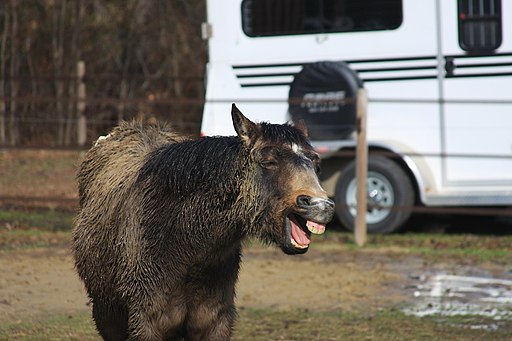
‘Laughing Donkey’ by Wendy from Wake Forest, USA, CC BY-SA 2.0 https://creativecommons.org/licenses/by-sa/2.0, via Wikimedia Commons

So I was asked to clarify about the donkey stuff in my first blog post (‘The oldest guide to the Camino’) — specifically about how it’s done!  I mean, really?  That’s what you want to know?  Well, in lieu of finding and posting a video to something that would probably get me fired should my search history become public, I’ll try to explain it plainly without being too graphic and getting you all bothered or excited.  Afterall, you’re walking on a spiritual journey, seeking peace and enlightenment, and probably don’t have too many changes of underwear with you.

The twelfth-century Pilgrim’s Guide suggests that the people of Vizcaya and Alava (now two provinces in the Spanish self-governing region of Euskadi/País Vasco/Basque Country) and those of Navarra have penetrative sex with their animals, perform oral sex upon them, and put chastity belts on them to stop others from doing likewise:

In some places, like Vizcaya and Alava, when they get warmed up, the men and women show off their private parts to each other. The Navarrese also have sex with their farm animals. And it’s said that they put a lock on the backsides of their mules and horses so that nobody except themselves can have at them. Moreover, they kiss lasciviously the vaginas of women and of mules.[1]

The author is really laying it on (pun intended), with the belt bit.  Not only do they engage in bestiality, but they’re jealous too.  Remember, jealousy is one of the seven deadly sins (although bestiality isn’t). 

The chastity belt is one of the much-exaggerated rumours connected with medieval sexuality, and this is probably one of the earliest references to them.  The idea, which was only really described by much later writers, is that a woman’s ability to have sex or masturbate (which was believed would cause mental illness) would be restricted by means of locked contraption that looks like a cross between a climbing harness and a leather and metal nappy.  If you don’t have the key to her heart, at least you can padlock the rest.  Of course this means that we have to presume that your average farmer in Vizcaya or Alava was worried that his neighbour would break in and romance the cutest mule in his stable, winning her over with carrots and apples, before suggesting a romp in the hay and performing cunnilingus on her.

Equally shocking — and I can only take the author’s word on this — the Basques and Navarrese apparently also kiss the vaginas of human women!  I know, I know, ‘how disgusting!’ I hear you say.  But in fairness, the Pilgrim’s Guide’s is reporting second-hand (‘it is said’), and since I am currently living in Navarra I am obliged to say that I believe such practices have generally been phased out.


[1] Denis Murphy’s very readable translation of the Pilgrim’s Guide (perhaps the most accessible translation in English on the internet), can be found here: https://sites.google.com/site/caminodesantiagoproject.  The quotation is taken from ‘Chapter VII. The lands and peoples along the Camino de Santiago’: https://sites.google.com/site/caminodesantiagoproject/chapter-vii

And they say that he got crazy once and that he tried to touch the sun…

By mLu.fotos from Germany – Perseids 2015 – Compilation 1 (All in One), CC BY 2.0, https://commons.wikimedia.org/w/index.php?curid=42351494

One of the most beautiful sights on the Camino is the sky above.  I recall lying in a field one night in August 2016 along with my friend Jay and a group of five or six other companions outside Carrión de los Condes, watching the annual Perseid meteor shower over the Meseta — the inspiration for the line ‘I’ve seen it raining fire in the sky’ in John Denver’s Rocky Mountain High.  The clear darkness was streaked with flecks from a cosmic arc welder and we sat eating cheese and bread, all wrapping up against the heavy dew and sleeping briefly and fitfully, before hitting the road with dawn lighting upon our backs.  At Tardajos, west of Burgos, in 2018 the warlike Mars showed red in the sky as the town prepared for a night-time concert that would start long after we peregrinos were peacefully tucked up in bed.  And like so many others I remember the sun setting over the ocean at Finisterre, and sharing a cigar with my friend Tyler on the pleasant walk back to the town in the evening gloom and deepening night.  But the sky is filled with more than just lights (there’s rain too, and by God plenty of it in Asturias!), and it’s also home to some of the Camino’s most interesting inhabitants.  Not least among these is the Red Kite (Milvus milvus), which was once native to Ireland until driven to extinction in the nineteenth century, although a breeding programme has helped reintroduce it to the Wicklow mountains using birds from Wales.[1]

By Charles J. Sharp – Own work, from Sharp Photography, CC BY-SA 4.0, https://commons.wikimedia.org/w/index.php?curid=90658674

The Red Kite is a reasonably large bird of prey, with a reddish-brown body about 60 cm long and a wingspan of 1.8m. You’re most likely to spot a Red Kite in the sky above you than on the ground or trees, so its profile rather than colour is what to look for, especially as it may look dark when silhouetted against the bright sky.  You’ll probably see it glide on outstretched wings that are white toward the edges and have five dark feathers, almost like fingers, at the end of each wing.  Its wings are angled (the leading edge is flat farthest away from the body but then angles in toward it), and these along with its deeply-forked tail give it a distinctive profile.  Other large birds of the Pyrenees include the Griffon Vulture, which is much bigger (body of about a 1m long and wingspan of 2.5m), which presents a much straighter wing edge when gliding (indeed its wings look almost rectangular),[3] and of course the large Golden Eagle, which also presents a flatter wing profile and seemingly more ‘fingers’ at the ends.[4]  The tail is the real giveaway, as the Griffon Vulture’s rounded diamond tail and the Golden Eagle’s longish flat tail both look nothing like the deep-v shape of the Red Kite.

If you do walk along the Camino in the regions around the Pyrenees, make sure to look up, and you’ll probably agree with John Denver:

And the Colorado rocky mountain high
I’ve seen it rainin’ fire in the sky
I know he’d be a poorer man if he never saw an eagle fly
Rocky mountain high
.[5]


[1] Royal Society for the Protection of Birds, ‘Red Kite’: https://www.rspb.org.uk/birds-and-wildlife/wildlife-guides/bird-a-z/red-kite.

[3] Image: https://www.rondatoday.com/griffon-vulture-of-the-serrania/ Image:

[4] Royal Society for the Protection of Birds, ‘Golden eagle’: https://www.rspb.org.uk/birds-and-wildlife/wildlife-guides/bird-a-z/golden-eagle.

[5] John Denver, ‘Rocky Mountain High’, https://youtu.be/eOB4VdlkzO4.

A recipe for pleasure: Tarta de Santiago (Santiago’s Cake)

By Katrin Gilger – Tarta de Santiago, CC BY-SA 2.0, https://commons.wikimedia.org/w/index.php?curid=89958476

Tarta de Santiago (or Torta de Santiago in Galego, the language of Galicia) is one of my favourite deserts and is a wonderful expression of what is best in Spanish cooking — good ingredients used simply but effectively.  Essentially, it’s a flat cake of almonds, eggs and sugar, in roughly equal measure, which mightn’t sound very adventurous, but I always get excited when I see it on the menu and I’m willing to risk a diabetic shock every time for that crumbly sweetness.  Since 2009 it has had Protected Geographical Indication (PGI) status, meaning that only tartas made in Galicia and adhering to certain quality guidelines (e.g. percentage of almonds) are permitted to be sold as Tarta de Santiago.

During the first lockdown in 2020, my friend and fellow peregrina Zoe and I had a remote bake off, where she clearly put my effort in the shade.  I’m not going to embarrass myself by putting up the photos. We both followed the same recipe by the Galician chef Alfonso López Alonso, which you can watch here on YouTube, or read here from the website of the Spanish newspaper El País.  I’ve translated it below, with a few additional notes.

Ingredients

  • 250g peeled almonds
  • 5 large eggs
  • 250 g sugar
  • 1/2 lemon [My note: rind only]
  • 1/2 teaspoon of cinnamon
  • 1/2 shot of spirits [My note: Galicia is known for spirits like orujo (grappa to Italians), if you don’t have anything similar just use something dry, like gin]
  • Icing/powdered sugar for decorating

Method

  1. Heat the oven to 180 degrees Celsius.
  2. Toast the almonds in a pan over a gentle heat, taking care not to burn them.  Remove and let them harden.
  3. While they are frying, beat the eggs with the sugar until they turn a pale colour.  Grate in the lemon and add the spirits and cinnamon.
  4. Blend half of the almonds thoroughly, until they’re like flour.  Blend the other half for less time, so that they retain a coarser texture.
  5. Add the almonds to the eggs with the sugar and mix with a spatula until smooth.
  6. Grease a detachable tin or flexible mould of 28cm diameter with butter.  [My note: make sure it’s well-greased, as this is a crumbly cake and you want it to be able to get it out of the tin without falling apart on you].  Put the mixture in the oven for 30 minutes until the surface is golden.  Cover with aluminum foil and bake for another ten minutes.  The exact time varies depending on the oven.  The best thing to do is check it by pricking it with a skewer or fork: if it comes out clean, it’s ready.
  7. Take out of the oven and leave it to cool for ten minutes before removing from the tin.
  8. When it is completely cool, sprinkle with the icing/powdered sugar.  If you want, make a stencil of the Cross of Santiago, which you can download from this blog. [My note: make sure it really is completely cool, otherwise the icing sugar will melt into it, instead of giving it the snow-covered appearance you want]

The wine of La Rioja

La Rioja is the smallest of Spain’s autonomous regions and is synonymous with quality wine in the way that Bordeaux is in France or Napa Valley in the US.  Indeed, it’s sometimes known as the Bordeaux of Spain, not least because French winemaking techniques were introduced to it in the later nineteenth century, which really helped it up its game and capitalise on its natural resources.

Two of its greatest resources are the tempranillo and garnacha grapes, which are often blended together in one of its staple reds.  Since varietal wines (wines made from a single type of grape) are increasingly popular, why blend?  Well think of it as a bit like your favourite football team.  You want your team to win and you want your manager (winemaker) to pick a winning team.  The manager has two types of player in the squad to choose from.  The first type is comprised of those silky smooth players who are a joy to watch on the ball and kick the scores that are an expression of the beauty of the game itself, but unfortunately they’re also a little too delicate at times and get muscled off the ball a little too easily — they’re the tempranillo.  The second type of player is that doughty ball carrier who knows how to get stuck into the opposition but isn’t always the prettiest to watch and a little lacking in the finer skills of the game — they’re the garnacha.  A team of tempranillos often won’t be heavyweight enough to win and a team of garnachas have the beef but not always the finesse needed for those game-winning scores.  But the manager who picks the right combination has a winning team on their hands; so it goes with blending tempranillo and garnacha.  Great wines can be made from either individually, but together they’re a satisfying combination that always stands a good chance of winning.

On the label of a Riojan wine you’ll often see Joven, Crianza, Reserva or Gran Reserva, and this refers to the aging of the wine, in barrel and bottle. Joven means young in Spanish and unsurprisingly refers to the youngest of the three; Crianza (meaning ‘cradle’) is the next oldest followed by Reserva, while Gran Reserva is the oldest.  Except for Joven wines, each of them must be aged in both oak barrels and in their bottle before being released onto the market.  Older wines tend to be more expensive partly due to storage costs (but you’ll often see restaurants put Crianza on their wine list and sell it at Gran Reserva prices, simply telling you it’s ‘Rioja’!).  However, although you often hear the expression ‘aging like a fine wine’ it doesn’t always follow that a young wine is an inferior product.  Not every wine is made for, or can withstand aging.  Some are best enjoyed sooner rather than later (which is particularly true of most white wines), while others are aged for longer in order to tease the fullest potential from the grapes.  And of course, fancy wine tastings are one thing, but wine drinking is quite another!

You’ll probably only spend about three days walking through La Rioja (roughly 60km), but don’t worry, their wine seems to be popular outside of there too.  If you’re interested check out the excellent official Rioja wine website, which even has a Rioja wine app that allows you to scan the bottle label for more information including how to purchase directly (especially useful if you find one that you’d love to have back home but don’t fancy dragging it another 600km to Compostela airport).

The botafumeiro: the oldest swinger in town

Apologies for the bad pun in the title, but one of the most impressive of all sights for pilgrims who reach Santiago de Compostela is the swinging of the botafumeiro — the great incense burner that hangs from the ceiling of the cathedral.  The botafumeiro (‘smoke expeller’) is essentially a version of the thurible (hand-swung incense burner) used in many church ceremonies, but this one is swung through the transept (side arms of the cathedral) by eight fully-grown men.  It stands at about a metre high and (depending on who you talk to/what you read) weighs anywhere between 50 and 160 kgs (8–25 stone), and watching it swing from the vault at over 60km/h you’re seriously hoping that the rope holds, because if it flies off it’ll be the equivalent of being hit by a small car…

References to the presence of a botafumeiro in the cathedral date back to the thirteenth century and it’s likely that there have been a few different ones employed over the centuries, not least because of theft.  In 1809 Napoleon’s troops stole the then silver botafumeiro and an iron one was used until the current botafumeiro of silver-plated brass was made in 1851.  Its job is to fill the air with the smell of sweet burning incense, a symbol of the purity of prayers rising up and also supposedly to cleanse the air of the smell of unwashed peregrinos!  In pre-modern times ‘bad air’ was considered a major cause of disease and so the botafumeiro was a health measure as much as a liturgical one.

It’s not operated every day, given the expense of incense and the effort needed, but normally you’ll get your chance to see it at the end of the weekly Pilgrim Mass and other special occasions.  Find a place in one of the pews in the transept, and if you’re really lucky, you’ll get to breathe in the history!

For a short video of the botafumeiro being swung, taken by a French peregrino in 2011, click here:

Yellow arrows and the Shell symbol


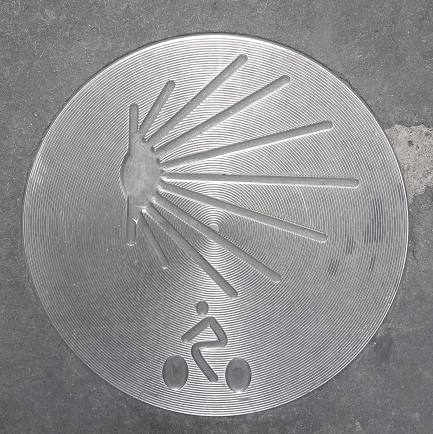
Yellow Arrows and Scallop Shell symbol

The yellow arrows and the scallop shell vie with each other for the honour of most recognisable symbol of the Camino and I think every perigrino’s heart has lightened on seeing them on those rare occasions when we’ve gone off the beaten track.  While the shell has a long association with the Camino, the yellow arrow is a modern innovation.  It was the brainchild of Don Elias Valiña Sampedroto in the 1970s, a priest now buried at one of the oldest churches on the Camino, Santa María la Real, at O’Cebreiro (Galicia).  Don Elias was a historian as well as a priest and instrumental in reviving the Camino, through the judicious application of yellow paint on walls, rocks, trees and roads.  A story goes that at one time he was in eastern Navarre with his bucket and brush when his suspicious behaviour drew the attention of the Guardia Civil (one of Spain’s police forces).  What was he doing so near the border they asked?  To which he replied magnificently, “Preparing a great invasion from France!”[1]

The shell as a symbol dates back to the middle ages (see my History of the Camino), and the modern abstract version has a stellar quality, as befits something guiding the way to Compostela (‘Field of the Star’).  I’ve heard it said that the direction of the rays of the shell points toward Compostela but that some of Spain’s autonomous regions orientate the symbol the other way around, with all the rays converging in the direction of the Compostela.  To be honest, in my experience there doesn’t seem to be any rhyme or reason and the arrows are a safer bet, but as long as you’re heading roughly west (sun to your left) you’re ok.  However, the star-like quality of the shell symbol has another significance, one that complements the colour scheme and speaks to the future as much as the past.

It is no coincidence that the colour scheme of the shell symbol — yellow markings on a blue background — matches the yellow stars on a blue background of the European Union flag. By the mid-1970s dictatorships like that of Franco in Spain or the Regime of the Colonels in Greece were increasingly anachronistic and incompatible with evolving EU ideals, and after Franco’s death in 1975 and the subsequent transition to democracy, post-Franco Spain increasingly sought to locate itself within a modern Europe.  The Camino became a means of promoting Spain’s place in Europe — after all the road to Compostela had once been one of Europe’s most travelled highways and a magnet for people from all over northern Europe.  In 1986 Spain joined the EU (then EEC), and the following year the Camino was designated the first Cultural Route of the Council of Europe, in recognition that:

For centuries, pilgrims could discover new traditions, languages and ways of life and return home with a rich cultural background that was rare at a time when long-distance travel exposed the traveller to considerable danger. Thus the Santiago Routes serve both as a symbol, reflecting ever one thousand years of European history, and as a model of cultural co-operation for Europe as a whole.[2]

If you’re from the UK and you voted for Brexit, you might want to think twice about getting that scallop shell tattoo!

[1] Anxo Saco, ‘Who was Elías Valiña? Follow the yellow arrow!’, https://caminotravelcenter.com/who-was-elias-valina-follow-the-yellow-arrow

[2] Council of Europe, ‘Santiago de Compostela Pilgrim Routes’, https://www.coe.int/en/web/cultural-routes/the-santiago-de-compostela-pilgrim-routes